2024 Strategy
Technological breakthroughs, wars, inequality issues, the growing focus on climate change and changing global dynamics are all transforming society. These developments have forced us to ask fundamental questions about our role as a university.
The focus over the past year was on finalising and embedding the current strategic initiatives as we prepare for a new strategic period. Since the launch of ‘Strategy 2024’ in 2019, Erasmus University Rotterdam (EUR) has been working hard to achieve positive societal impact. Using this mission as a foundation, we have achieved impressive milestones with our strategic projects, programmes and initiatives.
Looking back on this period, it is clear that we have taken steps to cement our reputation as a university that creates meaningful societal impact. From mission-driven research to innovative education and stronger links with local and global communities, our collective efforts demonstrate the power of collaboration. This period has also taught us that impact requires time and other investments. While we certainly achieved fantastic results, challenges remain – as does the need to support innovation. These challenges also provide opportunities to build stronger partnerships, foster interdisciplinary and transdisciplinary collaboration and deepen our commitment, in order to tackle societal problems with curiosity and responsibility.
Foundation for Strategy 2030
We laid the foundations for Strategy 2030 with Strategy 2024. Our mission to create positive societal impact remains at the heart of everything we do and is reinforced by our Erasmian values. Feedback from the midterm review of the current strategic period will be taken on board, with an even greater emphasis on impact as a central theme. We are building on the current themes of Engagement, Sustainability and Culture & Leadership, and doing so with greater focus and simplification. Implementation of the strategy will be more deeply embedded in the existing activities of the faculties and service units.
Over the past year, we worked with the organisation to flesh out the basic outline of the 2025–2030 strategic framework. For example, we organised meetings for faculties and departments to gather input for our strategy. We also set up several working groups to formulate strategic ambitions and priorities for the current strategic themes. Experts on key topics such as AI and internationalisation also provided important input for our new strategy, as did an internal reflection group. The results of the various working groups formed the basis for the strategic framework, which we will elaborate on and develop into an implementation plan in 2025. We will officially launch the new EUR strategy during the opening of the 2025–2026 academic year.
Impact and community engagement
To further strengthen EUR’s impact-driven mission in the coming years, the role of Strategic Dean for Impact & Engagement was created in 2024. It is a temporary role, stemming in part from EUR’s current and new strategies. The Strategic Dean’s responsibilities were jointly determined by the Executive Board and the Board of Deans. The aim of the new position is to boost the EUR-wide impact strategy, including strengthening and leveraging the university’s relationship with society – thus increasing the impact of our education and research. Professor Arwin van Buuren, a long-serving EUR professor in the field of Public Administration who has been closely involved with the current strategy, was appointed to this position in April 2024.
Excellent and impactful results
Over the past twelve months, a number of excellent and impactful initiatives reached maturity. Results were achieved within the faculties and service units of which EUR can be proud; it is also important to increase the visibility of our impact for both internal and external stakeholders. For these reasons, we organised the Societal Impact Days in October. For two days, EUR celebrated the impact it had made as a university through its research, education and engagement.
Impact Report
The Societal Impact Days also saw the launch of the first EUR Impact Report, which included examples of impactful initiatives from the current strategic period. In recent years, EUR has focused on key changes to become an impact-driven university and increase our impact potential with various initiatives. Some of the most compelling initiatives and developments were included in the report. The examples illustrate impactful education, research and engagement. Of course, the transition to an impact-driven university does not happen all by itself. The report also shares a number of lessons and challenges. The report shows that our motto, Making Minds Matter, is more than just words; it is a lived reality. We show that we are truly a committed university; we have strong roots in the Rotterdam region, while remaining closely connected to our colleagues and partners around the world.

Sustainability
Sustainability at EUR
In 2023, the EUR Executive Board released a statement acknowledging the climate and environmental emergency. Sustainability is a key theme for the university, and in 2024, EUR built on the enhanced sustainability programme from 2023. For example, sustainability dialogues within the EUR community launched in 2023 were completed in 2024, leading to concrete actions such as the start of development of an initial version of guidelines for collaboration with the fossil fuel sector and organising the Sustainability Summit in October.
Although EUR still faces plenty of sustainability challenges, our efforts have been recognised by students. The university ranked third on the SustainaBul for higher education. This ranking has been published annually since 2012 by Studenten voor Morgen (Students for Tomorrow). Participating institutions are judged on their sustainability in research, education and operations, and based on an integrated approach.
Sustainability in education and research
2024 also saw a number of fantastic initiatives around sustainability in education and research. They included a pilot for an introductory course on sustainability and a project for a classification method: sustainability in education. In addition, early-career researchers were offered a unique learning experience, being introduced to various methodological approaches in sustainability transition research and their role as transformative researchers. The latter initiative was offered by the Design Impact Transition (DIT) Platform and the Dutch Research Institute for Transitions (DRIFT), in collaboration with the Sustainability Transitions Research Network (STRN) and the Network of Early Career Researchers in Sustainability Transitions (NEST).
Sustainability on campus
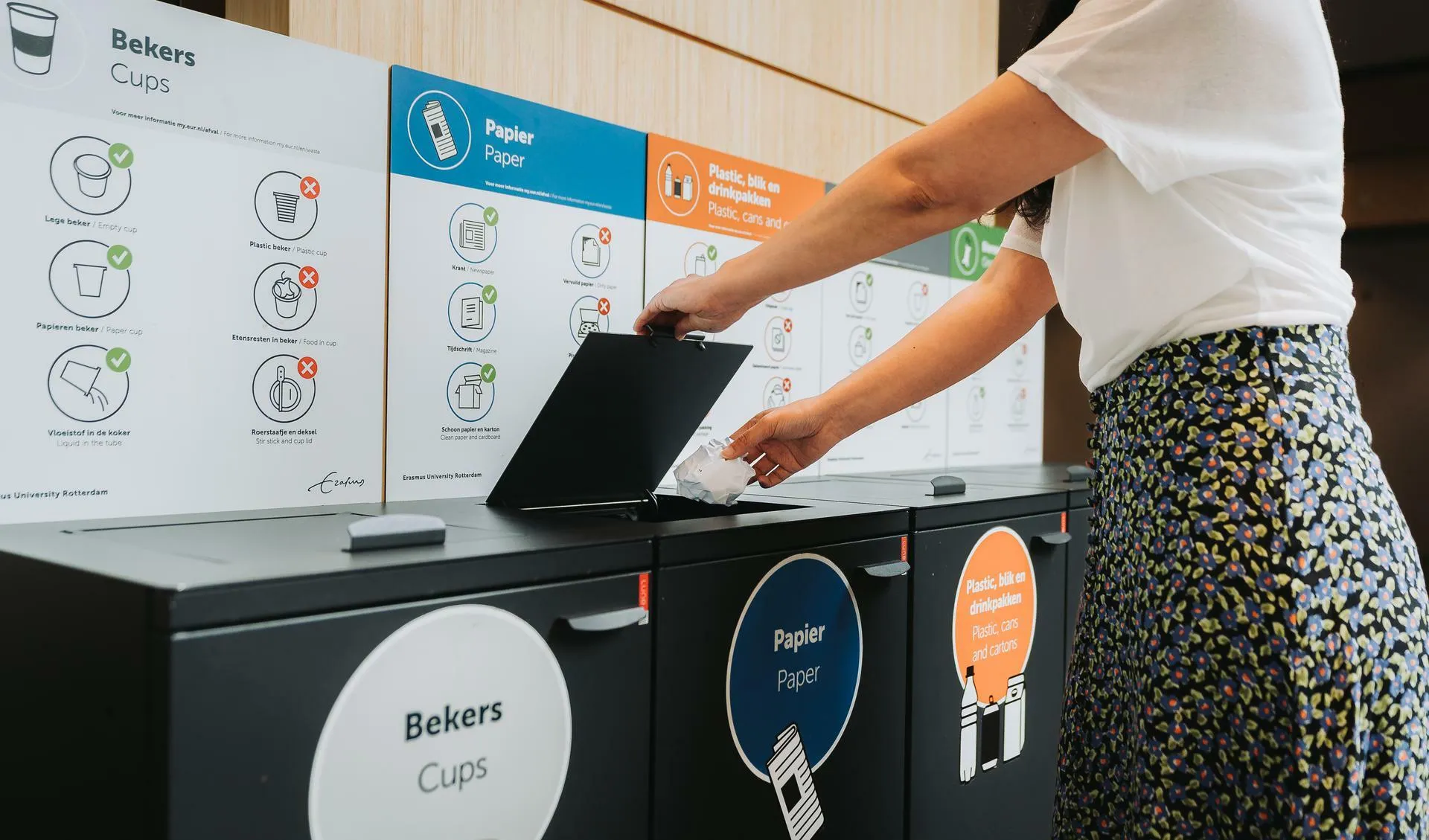
Once again, the campus became increasingly sustainable last year. For example, the new waste management contract was awarded to Seenons, an innovative company that will contribute to our ambition of zero waste by 2030. The renovation of the Tinbergen Building has started; it is being done in a very sustainable way, and has been awarded a BREEAM Outstanding design certificate. In addition, a natural bank has been created around the pond near the Pavilion, featuring a large green space filled with native trees and shrubs to promote biodiversity. Finally, the past year has seen work on the development of the Food & Catering 2030 Roadmap, in which the Planetary Health Diet is a key objective.
You can read more about our sustainability initiatives in education, research and operational management in our sustainability report at eur.nl/en.
Culture and leadership
Engaged employees are the foundation for societal impact. As we build on the EUR Strategy and develop into an engaged university, our culture must encourage engagement. Leadership is a crucial element of engagement, and remains a key part of the strategy for the years ahead. In 2024, the leadership programme was shaped by professionalising the available training courses and toolboxes and connecting managers in communities.
Recognition & Rewards
In 2024, EUR made significant progress in implementing and embedding the concepts of the Recognition & Rewards programme. This year, the focus was on developing practical tools, strengthening cooperation with HR, encouraging faculty development and expanding knowledge sharing at the national level. These developments contributed to a more inclusive and diverse academic culture within EUR.
Strategic collaborations
At the start of the current strategy period, there was a strong focus on strategic collaborations, both within the region and internationally. Indeed, at a time of increasingly complex societal challenges at both the global and local levels, strategic collaborations are critical for universities to achieve a clearer understanding of and find a better approach to complex societal issues. Meanwhile, important alliances, such as the international collaborations under the European University Alliance UNIC, the regional collaboration within Convergence (EUR – TU Delft – Erasmus MC) and the Leiden-Delft-Erasmus Universities (LDE) alliance, are increasingly becoming an integral part of EUR. It is clear that partnerships remain an essential focus for EUR, now and in the future.
SPOTLIGHT
Societal Impact Days
The first Societal Impact Days, held in October 2024, were a success. During these inspiring days, people from the internal and external EUR communities came together to learn, network and reflect on innovative solutions to societal challenges and the role played by the university. The first day was mainly about education, while the focus of the second day was impact and engagement. The event was open to staff as well as the external stakeholders with whom EUR collaborates.