

Introduction
In this chapter, we report on the key financial developments, performance and challenges that affected the university last year. We reflect on the choices made (primarily strategic choices), as well as their sustainable impact on the university, students, staff and society.
We also look ahead and provide insight into expected developments over the next five years.
The past year has been characterised by sweeping changes in higher education, both nationally and internationally. The dynamic political climate and economic conditions have challenged us to strengthen the range of programmes we offer, increase research performance and expand our social role as a knowledge institution at the regional and global level. Specific attention was given to innovation in accommodation and digitalisation (such as AI), internationalisation and the promotion of student and staff wellbeing. These initiatives will contribute to the stability and future-proofing of our institution.
The environment is changing in terms of the energy transition, inflation, a more sustainable economy and digitalisation, which also affects the university’s financial position. These issues are compounded by the spending cuts to higher education announced by the Schoof government, including the discontinuation of the starter and incentive grants and the introduction of the Balanced Internationalisation Act. These measures have increased the financial pressure, which was already high due to wage and price increases and labour market tensions. The discontinuation of the grants is also expected to affect staff workloads and wellbeing. These challenges make frequent information on where we stand financially even more important.
Despite these financial and other challenges, we remain committed to creating an inclusive learning and working environment with societal impact. Together with our students, staff and partners, we will stay the course. It is a course that is reflected in the new strategic period (2025–2030) on which the university has recently embarked.
In this chapter, the consolidated financial position of Erasmus University Rotterdam (EUR) is compared with both the 2024 budget and the previous year. The consequences of this financial position on the ratios are then identified. This is followed by the section on continuity and the section on the Clarity Memorandum. The chapter concludes with an explanation of the spending of the Administrative Agreement funds.
In accordance with the reporting rules, the income and expenditure of the related parties and the education and research activities of Erasmus MC are consolidated in addition to EUR’s income and expenditure. This means that:
- The consolidated operating income concerns the income and expenditure of EUR, the related parties and the education and research activities of Erasmus MC.
- The consolidated result financial position concerns EUR, the related parties and the education and research activities of Erasmus MC.
- The consolidated net result financial position concerns EUR and the related parties, excluding the education and research activities of Erasmus MC.
Financial position
table 21
| In € million | Actual 2024 | Budget 2024 | Actual 2023 | Deviation from the budget | Deviation from 2023 | |
|---|---|---|---|---|---|---|
| Central government grant | 455,5 | 457,2 | 429,8 | -1,7 | 25,7 | |
| Tuition fees | 87,5 | 88,9 | 80,9 | -1,4 | 6,6 | |
| Income from work commissioned by third parties | 244,7 | 247,2 | 236,0 | -2,5 | 8,7 | |
| Other income | 118,1 | 122,7 | 115,8 | -4,6 | 2,3 | |
| Total income | 905,8 | 916,0 | 862,5 | -10,2 | 43,3 | |
| Personnel expenses of staff on payroll | 617,2 | 628,8 | 572,0 | -11,6 | 45,2 | |
| Staff not on payroll | 34,8 | 31,1 | 37,9 | 3,7 | -3,1 | |
| Depreciation | 42,2 | 42,8 | 54,1 | -0,6 | -11,9 | |
| Accommodation costs | 43,8 | 46,5 | 41,7 | -2,7 | 2,1 | |
| Other expenses | 195,7 | 187,4 | 187,2 | 8,3 | 8,5 | |
| Total expenses | 933,7 | 936,6 | 892,9 | -2,9 | 40,8 | |
| Net income (expense) | -27,9 | -20,6 | -30,4 | -7,3 | 2,5 | |
| Financial income and expenditure | 10,8 | 2,7 | 7,5 | 8,1 | 3,3 | |
| Taxes | 0,0 | 0,0 | 0,2 | 0,0 | -0,2 | |
| Result for the year | -17,1 | -17,9 | -22,7 | 0,8 | 5,6 | |
| Third-party share of result | -13,5 | 7,0 | -3,0 | -20,5 | -10,5 | |
| Net result for the year | -3,6 | -24,9 | -19,7 | 21,3 | 16,1 |
Analysis of the 2024 result (consolidated)
In the analysis of the result, we will start by reflecting on the non-recurring income and expenditure affecting the result and then analyse the deviations from the budget, followed by the deviations from 2023.
The net result was € -3.6 million, after deduction of the ‘Third-party share of the result’ of € -13.5 million. The negative ‘result’ of €17.1 million includes FGG/Erasmus MC and is heavily influenced by the non-recurring income and expenditure (see the table entitled ‘Non-recurring income and expenditure affecting the 2024 result, including FGG/Erasmus MC’). Apart from the non-recurring items, the negative result for FGG/EMC is caused by targets that were included in the budget but not fully met.
Non-recurring income and expenditure affecting the 2024 result, including FGG/Erasmus MC
table 22
| Amounts x € 1 million | 2024 | 2023 | Difference between 2024 and 2023 |
|---|---|---|---|
| Result for the year | -17,1 | -22,7 | 5,6 |
| 1. Addition to reorganisation provision | 5,1 | ||
| 2. Additions to other provisions | 8,7 | ||
| 3. Impairment of assets in development | 1,1 | ||
| 4. Contribution towards an MRI scanner for EMC | 1,5 | ||
| Total non-recurring factors impacting the result | 16,4 | 21,5 | |
| Result after non-recurring factors impacting the result | -0,7 | -1,2 | 0,5 |
The result after non-recurring items (including FGG/Erasmus MC) is substantially better than budgeted. The result includes non-recurring items that impact the result after non-recurring items and were not taken into account in the budget.
- Additions to the reorganisation provision for both FGG/Erasmus MC and EUR Woudestein;
- The creation of additional provisions, including for asbestos and litigation;
- A non-recurring write-off of work in progress for the Tinbergen Building;
- The contribution by EUR towards an MRI scanner for EMC (Healthcare segment) for scientific research purposes.
Comparison with the 2024 budget
The substantially more positive normalised result as compared to the budget is the result of realised savings as well as a certain degree of conservative budgeting by the organisational units.
In 2024, various measures were initiated to keep the budget within the set limits and to strengthen our financial resilience going forward. For example, we initiated several rationalisation programmes, including the redesign of the service delivery model and the more efficient use of support capacity. We also actively focused on limiting the hiring of contractors and reducing unused leave. In addition, we committed to improving management information so that adjustments can be made faster and more effectively. A specific example is the development of dashboards to track staffing costs and identify constraints around project funding. We will continue this strategy in 2025.
Among the faculties, the results achieved for 2024 are diverse. An internal analysis shows that there was a cautious budgetary approach of at least €10 million in faculty budgets, which the faculties have already identified when issuing their forecasts. Faculties with poor financial results are working on recovery plans to become financially sound in the long term.
The results for most support service units are slightly negative. However, due to a strong positive result for the Real Estate & Facilities (RE&F) department, the overall result for support services is positive. The positive result for RE&F is partly due to delays in the implementation of the investment programme and partly to budget conservatism. The budget process is being tightened up as part of ongoing improvements.
The related parties also posted better-than-budgeted results, particularly EUR Holding BV and RSM BV.
Income compared with the budget
- The central government grant was lower than budgeted due to lower spending of the Administrative Agreement funds (-/- €7.2 million). This can be attributed to a later start of spending due to delayed award of grants, as well as a longer lead time for design and implementation due to vacancies. This was partly offset by higher compensation for wage and price rises (+/+ €5.7 million), resulting in revenue that was almost equal to the budget. We expect grants to be spent in line with the budget in future years.
- The decline in the number of funded students in the 2023/2024 and 2024/2025 academic years had a negative impact on the figures for tuition fee income.
- The lower figure for ‘Income from work performed for third parties’ is caused by lower income from the education portion of the third money stream. This is partly due to the termination of a scholarship programme (€0.4 million). In addition, the revenue from contract education was disappointing. The annual amount of this income is uncertain because of the award process.
- The lower figure for ‘Other income’ was mainly caused by disappointing income from external services for related parties, in particular EUR Holding and its operating companies (-/- €5.4 million).
- The rise in interest rates resulted in an increase in the interest income portion of ‘Financial income and expenditure’. The earlier start of expenditure related to the Tinbergen Building was also taken into account. As a result, the cash and cash equivalents were higher than budgeted.
Expenses compared with the budget
- The ‘Personnel expenses for staff on payroll’ item is lower than budgeted because vacancies were filled later or not at all as a result of labour market shortages, postponed projects (HOKA) and the limited utilisation of Administrative Agreement funds. However, more (temporary) replacements were hired to continue ongoing projects and programmes. This increased the ‘Staff not on payroll’ item. A number of staffing provisions were also made, and there were more transition payments.
- The lower figure for ‘Depreciation expenses’ was caused by the fact that we have had to use the old sports building as an examination venue for longer (-/- €0.8 million); as a result, we are depreciating it less quickly than budgeted. Earlier completion of a number of CIO projects resulted in higher depreciation (+/+ €0.2 million) and, following a correction of the assets under construction, some of these assets were retroactively depreciated (+/+ €0.1 million).
- Lower costs for district heating (-/- €1.6 million) due to a winter that was less severe than expected and lower cleaning and maintenance contracts (-/- €1.6 million) resulted in a lower figure for ‘Accommodation costs’.
- The ‘Other expenses’ included a €10.9 million target for FGG/Erasmus MC. This target was not fully met, resulting in higher-than-budgeted other expenses. The ‘Third-party share of the result’ concerns the share of Erasmus MC’s education and research activities (E&R). This result is substantially more negative than initially budgeted. It should be noted that significant adjustments were made to the budget for FGG/EMC as presented in the 2024 Financial Statements. As a result, the final budget result for 2024 set by the FGG came to nil, instead of the positive €7 million included in the EUR budget. The 2024 result for the education and research activities of Erasmus MC (compared with the nil adjusted budget result) was significantly affected by non-recurring income and expenditure, as set out in Table 22, showing normalisations applied for 2024 (and not budgeted for).
Comparison with actual results for 2023
Income compared with actual 2023 results
- The higher ‘Central government grant’ figure was partly caused by 5.1% compensation for wage and price rises from the Ministry of Education, Culture and Science. In addition, more funds were made available nationwide (+/+ €3.4 million) for quality funding for universities.
- The rise in tuition fee rates contributed to an increase in ‘Tuition Fee Income’. In the 2024/2025 academic year, the statutory tuition fees increased by 9.3% compared with 2023/2024. The institution tuition fees increased by 5% on average. There was also slight growth in student numbers of around 150.
- The higher figure for ‘Income from work performed for third parties’ is due to higher income from indirect funding and the research portion of the third money stream resulting from the award of a number of projects, grants and funds from UNIC, the European alliance of universities in post-industrial cities. The EUR also has a coordinating role in some projects, resulting in higher returns.
- The higher figure for ‘Other income’ has several causes. For example, pro rata VAT revenue was higher than budgeted and parking rates were increased – partly due to inflation – resulting in higher parking revenue.
- The increase in ‘Personnel expenses for staff on payroll’ was caused by an increase in wage costs due to the collective labour agreement for universities from 1 July 2024 and an increase in the average number of FTEs. In 2024, a conscious effort was made to reduce expenditure on ‘Staff not on payroll’. This effort was successful.
- The lower depreciation expenses in 2024 were largely due to a non-recurring impairment of the FGG/EMC Eread real estate project in 2023 (€14.2 million), which reduced the depreciation base in 2024. Only a small number of non-recurring impairments occurred in 2024, such as the write-down of the previous work in progress on the Tinbergen Building (€1.1 million).
- The ‘Accommodation costs’ relating to energy costs were higher because the FGG/Erasmus MC contracts for electricity and gas had been renewed and raised to current market rates. Consumption did not change. The ‘Other expenses’ item was higher due to an addition to the provision for bad debts and an increase in management and administrative costs.
Expenditure compared with actual 2023 results
- The increase in ‘Personnel expenses for staff on payroll’ was caused by an increase in wage costs due to the collective labour agreement for universities from 1 July 2024 and an increase in the average number of FTEs. In 2024, a conscious effort was made to reduce expenditure on ‘Staff not on payroll’. This effort was successful.
- The lower depreciation expenses in 2024 were largely due to a non-recurring impairment of the FGG/EMC Eread real estate project in 2023 (€14.2 million), which reduced the depreciation base in 2024. Only a small number of non-recurring impairments occurred in 2024, such as the write-down of the previous work in progress on the Tinbergen Building (€1.1 million).
- The ‘Accommodation costs’ relating to energy costs were higher because the FGG/Erasmus MC contracts for electricity and gas had been renewed and raised to current market rates. Consumption did not change.
- The ‘Other expenses’ item was higher due to an addition to the provision for bad debts and an increase in management and administrative costs.
Balance sheet and development in cash flows
table 23
| 2024 | Budget 2025 | Planning 2026 | Planning 2027 | Planning 2028 | Planning 2029 | |
|---|---|---|---|---|---|---|
| Assets | ||||||
| Fixed assets | ||||||
| Intangible fixed assets | 1,8 | 13,8 | 12,6 | 11,4 | 10,3 | 9,3 |
| Tangible fixed assets | 289,6 | 284,6 | 320,5 | 339,0 | 323,4 | 282,8 |
| Financial fixed assets | 6,3 | 1,5 | 1,5 | 1,5 | 1,5 | 1,5 |
| Total fixed assets | 297,7 | 300,0 | 334,6 | 351,9 | 335,2 | 293,6 |
| Current assets | ||||||
| Inventories | 0,0 | 0,0 | 0,0 | 0,0 | 0,0 | 0,0 |
| Receivables from tuition fees | 0,6 | 0,0 | 0,0 | 0,0 | 0,0 | 0,0 |
| Other receivables | 63,1 | 39,1 | 39,4 | 39,8 | 41,7 | 40,4 |
| Cas and cash equivalents | 164,2 | 160,2 | 122,5 | 119,4 | 131,8 | 171,8 |
| Total current assets | 227,9 | 199,4 | 161,9 | 159,2 | 173,5 | 212,2 |
| Total assets | 525,6 | 499,3 | 496,5 | 511,1 | 508,7 | 505,8 |
| Liabilities | ||||||
| Equity | 207,5 | 206,8 | 206,8 | 206,8 | 209,8 | 209,8 |
| Provisions | 34,5 | 28,6 | 26,0 | 26,0 | 26,0 | 26,0 |
| Non-current liabilities | 7,0 | 6,7 | 24,1 | 60,5 | 56,8 | 53,0 |
| Current liabilities | 276,6 | 257,3 | 239,7 | 217,8 | 216,2 | 217,1 |
| Total liabilities | 525,6 | 499,4 | 496,5 | 511,1 | 508,8 | 505,9 |
Assets compared with the 2024 budget
- The decrease in ‘Tangible fixed assets’ was mainly caused by divestments of data centres that are no longer in use.
- The increase in ‘Financial fixed assets’ is due to taking out a deposit worth €4 million with EUR Holding BV and a €560,000 loan provided by Stichting Sport for the renovation of the Skadi rowing building in Rotterdam.
- ‘Other receivables’ increased by €14 million due to funds being shifted from cash and cash equivalents to deposits.
- ‘Cash and cash equivalents’ increased due to Administrative Agreement funds being received but not fully spent in 2024. There were also delays in the implementation of a number of accommodation projects.
- The ‘Equity’ item decreased following the addition of the negative result for 2024. The 2024 budget had assumed a more negative result.
- The increase in ‘Provisions’ was caused by an increase in provisions for personnel (including for reorganisations), asbestos, and claims and litigation.
- The figure for ‘Tangible fixed assets’ is stable compared with the previous year. Although there were further investments in CiO (including the start of the Tinbergen Building renovations) in 2024, there was also depreciation of existing assets.
- Out of the total increase in ‘Cash and cash equivalents’, €24.7 million can be explained by income from the Administrative Agreement funds. This amount was not fully spent in 2024. In addition, there was an increase of €12.2 million in revenue from instalments on projects invoiced or received in advance.
- The negative result for 2024 was deducted from the ‘Equity’ item. This explains the decrease in 2024.
- The increase in ‘Current liabilities’ of €24.7 million can be explained by the starter and incentive grants beginning later due to vacancies.
Liabilities compared with the 2024 budget
- The ‘Equity’ item decreased following the addition of the negative result for 2024. The 2024 budget had assumed a more negative result.
- The increase in ‘Provisions’ was caused by an increase in provisions for personnel (including for reorganisations), asbestos, and claims and litigation.
- ‘Current liabilities’ increased due to delayed spending of the Administrative Agreement funds for sector plans and starter and incentive grants. The delay was due to projects starting later and vacancies. The remaining funds will be spent after 2024 in line with the long-term budget.
Assets compared with the actual 2023 results
- The figure for ‘Tangible fixed assets’ is stable compared with the previous year. Although there were further investments in CiO (including the start of the Tinbergen Building renovations) in 2024, there was also depreciation of existing assets.
- Out of the total increase in ‘Cash and cash equivalents’, €24.7 million can be explained by income from the Administrative Agreement funds. This amount was not fully spent in 2024. In addition, there was an increase of €12.2 million in revenue from instalments on projects invoiced or received in advance.
Liabilities compared with the actual 2023 results
- The negative result for 2024 was deducted from the ‘Equity’ item. This explains the decrease in 2024.
- The increase in ‘Current liabilities’ of €24.7 million can be explained by the starter and incentive grants beginning later due to vacancies.
Changes in ratios
table 24
| Ratios | Definition | Inspectorate alert threshold | Actual 2024 | Actual 2023 |
|---|---|---|---|---|
| Liquidity | (Receivables + cash and cash equivalents) / current liabilities | < 0,5 | 0,82 | 0,79 |
| Solvency II | (Equity + provisions) / total assets x 100% | < 0,30 | 0,46 | 0,49 |
| Absolute amount of cash and cash equivalents | Balance sheet position as at the balance sheet date |
< € 2 miljoen | 164,2 | 148,6 |
| Alert threshold for supervision of public equity | ||||
| Ratios | Definition | Inspectorate alert threshold | Actual 2024 | Actual 2023 |
| Excessive equity | The alert threshold for excessive public equity is: (0.5*building acquisition value*1.27)+(book value other tangible fixed assets)+(size-dependent calculation factor*total income) | Actual public equity > normative equity | Actual public equity: €170 million. Normative equity: €382.5 million | Actual public equity: €166.9 million. Normative equity: €340 million |
| Other ratios of the Inspectorate of Education | ||||
| Ratios | Definition | Inspectorate alert threshold | Actual 2024 | Actual 2023 |
| Return (1-year) | Result year t/total income t x 100% | < -10% | -0,4% | -2,3% |
| Profitability (2-year) (retrospective) | ∑ (Result year t-1; result year t) / ∑ (total income year t-1; total income year t) x 100% | < -5% | -1,3% | -2,1% |
| Profitability (2-year) (prospective) | ∑ (Result year t; result year t+1) / ∑ (total income year t; total income year t+1) x 100% | < -5% | -0,4% | -2,5% |
| Profitability (3-year) (retrospective) | ∑ (Result year t-2; result year t-1) / ∑ (total income year t-2; total income year t-1) x 100% | < 0% | -0,4% | -0,4% |
| Profitability (3-year) (prospective) | ∑ (Result year t+1; result year t+2) / ∑ (total income year t+1; total income year t+2) x 100% | < 0% | -0,4% | -2,7% |
| Buffer capital | Equity / total income x 100% | < 5% | 22,9% | 24,5% |
Development of solvency
Solvency decreased due to a sharp increase in current liabilities, mainly due to an increase in unspent Administrative Agreement funds.
Development of liquidity
Both the Inspectorate of Education and internal guidelines use an alert threshold of 0.5 for the liquidity ratio. Based on the 2024 consolidated figures, the liquidity ratio for 2024 exceeds the alert threshold of 0.5. The university has sufficient cash and cash equivalents to meet its short-term obligations. The liquidity ratio is subject to changing market conditions and may vary. As a result, the alert threshold serves as an indicator rather than a fixed figure. During the year, liquidity is monitored in the planning and control cycle using the liquidity forecast.
The expected real estate investments for the CiO III and IV programme in the coming years (and in particular the Tinbergen Building renovations) will put pressure on the liquidity position. A need for financing is not expected to arise until the end of 2025 at the earliest. This will happen if the size and timing of the CiO investments are the same as in the recent investment estimate. See also the notes in the ‘Investments’ section.
Alert threshold for potentially excessive public equity
At the end of the 2024 financial year, EUR’s actual equity (the public portion of the equity) amounted to €170 million. The normative equity for EUR at the end of 2024 was €382 million.
The public equity therefore does not exceed the alert threshold for potentially excessive public equity of educational institutions.
The figures shown in the consolidated balance sheet and the consolidated statement of income and expenditure form the basis for calculating the actual equity and the normative equity.
Continuity
This section provides insight into EUR’s policies, their expected impact on our financial position and the related risks for 2025 and beyond. The information provided in this section is in line with the requirements of the Ministry of Education, Culture and Science in the Regulation on Annual Reporting in Education. The report of the supervisory body is included in Chapter 1 of this annual report.
The long-term budget, which is part of the long-term plan adopted by the Executive Board on 19 November 2024 and approved by the Supervisory Board on 16 December 2024, forms an important basis for this continuity section. The long-term budget covers a period of five years. There are a number of uncertainties that could impact the finances of our university. For instance, spending cuts have been announced without specific details, and there have been new developments that are expected to have significant negative impact on our financial results. These developments include the proposed stricter regulation of the international enrolment, which, if implemented, is expected to lead to a steep drop in the number of international students.
We will start with an explanation of key developments, followed by an explanation of elements of the long-term budget.
Key external developments
Political and economic environment
The Schoof government is cutting funding to the university for both research (including by ending starter and incentive grants) and education (including through the Balanced Internationalisation Act). The university was already under pressure due to increases in salaries and material costs not fully compensated for by the Ministry of Education, Culture and Science, the need to invest in real estate and a declining baseline estimate (macro framework). Accordingly, EUR started implementing mitigation measures in 2024. However, the new cuts from the Ministry of Education, Culture and Science are hitting the university hard and we need to take more rigorous measures to ensure EUR’s long-term viability. The abrupt termination of the starter and incentive grants from 1 January 2025 has had a detrimental impact on our financial situation, but also on the extent to which we can provide space for talent development, on workloads, and on our capacity to contribute to socially relevant or economic issues. We were able to partly mitigate the financial impact by withdrawing from commitments where possible, specifically where no obligations, long-term or otherwise, existed. The details of the Balanced Internationalisation Act are currently being worked out. The negative financial effects could be significant, and could even have a substantial, material impact on our organisation. Based on scenario analyses, we found that the Balanced Internationalisation Act would have an impact of around €15 million in the best-case scenario, but the impact could be as high as €75 million in the worst-case scenario. It is not only EUR’s finances that would be affected, but also the international character and thus the foundation of the university.
The impact of the Balanced Internationalisation Act has not yet been reflected in the long-term budget, due to the high degree of uncertainty surrounding it. The uncertainty around how and when certain effects will materialise requires a high degree of flexibility. It is essential to increase our agility and reduce dependence on a government that is not consistent in its policies or in honouring past agreements. EUR continues to invest in the quality of its education, and we believe in the positive economic and social effects of the university’s work over the long-term.
The organisational units have taken measures to mitigate the negative financial results. For instance, recovery plans have been drawn up by some faculties, and the service units and executive staff have adopted a target that will see them collectively save almost €15 million. Real estate plans have also been scaled back where possible; this was done without compromising legal requirements or strategic ambitions around sustainability. The budgeted negative result for 2025 is acceptable, given our strong capital position. Additional, more far-reaching, measures will be needed to ensure EUR’s long-term viability and to deal with the financial impact of the government’s spending cuts. These measures will be developed in 2025. By way of illustration, these measures include the introduction of a hiring desk/office for staff recruitment, harmonising and consolidating our operational management (with other institutions where possible), reviewing our range of minors, and increasing second and third money streams, and funds from commercial exploitation.
Strategic partnerships
EUR’s mission is to create a positive societal impact. In a world in which climate change, social inequality, technological developments and economic transitions play an increasingly important role, EUR has positioned itself as a knowledge institution that works with public authorities, businesses and civil society organisations to develop sustainable solutions. This calls for a flexible, innovative and entrepreneurial approach, in which cooperation is key.
EUR continues to develop as a university that connects, undertakes and innovates. Our Erasmian Values – socially engaged, world citizenship, connecting, an entrepreneurial spirit and open-mindedness – lie at the heart of EUR’s strategy. With strong regional roots and an international outlook, we continue to build a future where we contribute to a more just, sustainable and innovative society through our education, research and engagement.
Partnerships
table 25
| Partnerships | Budget* |
|---|---|
| Strategy | 5,8 |
| Convergence | 7,7 |
| LDE (incl. trainee minors) | 2,4 |
| Medical Delta | 0,4 |
| Culture & Campus | 0,1 |
| UNIC | 0,3 |
| Codarts/RASL | 0,3 |
| Knowledge Development Centres (incl GOVlab) | 0,2 |
| Total | 17,2 |
| * Amounts x €1 million |
Expected trends in student numbers
table 26
| Academic year | Actual 24/25 | B 24/25 | B 25/26 | B 26/27 | B 27/28 | B 28/29 |
|---|---|---|---|---|---|---|
| Number of EUR students* | 31,473 | 31,354 | 31,422 | 31,316 | 31,327 | 31,43 |
| from EEA | 28,914 | 28,748 | 28,771 | 28,627 | 28,594 | 28,647 |
| non-EEA | 2,559 | 2,606 | 2,651 | 2,689 | 2,733 | 2,783 |
For the next few years, we expect the number of students to stabilise, with a change to the ratio of Bachelor’s to Master’s students: first, the number of Master’s students will increase until 2027, and then decrease, while the number of Bachelor’s students will move in the opposite direction. The ratio of European Economic Area (EEA) students to non-EEA students is also changing, with a decrease in EEA students and an increase in non-EEA students. This does not yet include the impact of the Balanced Internationalisation Act, which is expected to lead to a drop in the number of international students, which means the numbers presented will be lower.
The decline in EEA students has already led to a reduction in student-related funding (baseline estimate impact). In addition, the Balanced Internationalisation Act will further reduce the central government grant and tuition fee income. Scenario analyses show that the financial impact for the EUR could be up to €75 million a year. In this scenario analysis, we assume that we will lose all international students. This has not yet been incorporated into the budget.
Rise in staffing costs and labour market shortages
In 2024, the collective labour agreement negotiations led to a 3.7% increase in wage costs from September 2024. On 1 January 2025, wages rose by another 1%. It is still not clear whether this wage increase will be compensated in any way by the Ministry of Education, Culture and Science.
The collective labour agreement requires educational institutions to grant more permanent contracts to employees. This is at odds with our declining budgets, increasing the pressure on the financial result. Having a higher number of permanent staff makes EUR less agile, leading to reduced financial flexibility. Meanwhile, negotiations with the union for a new collective labour agreement have begun.
Workloads remain high. Funds for starter and incentive grants, which were intended to reduce workloads, will no longer be allocated from 2025. Although the coalition agreement included funds for reducing workloads and for talent policies, the allocated amount is significantly lower than before.
Expected trends in staffing
table 27
| FTE numbers Total – including EMC/FGG and related parties | ||||||
|---|---|---|---|---|---|---|
| FTE | 2024 | 2025 | 2026 | 2027 | 2028 | 2029 |
| FTE academic staff | 2,337 | 2,327 | 2,294 | 2,268 | 2,264 | 2,264 |
| FTE doctoral candidates | 957 | 934 | 909 | 892 | 881 | 881 |
| FTE student assistants | 120 | 141 | 140 | 142 | 144 | 144 |
| FTE support staff | 2,98 | 3,022 | 3,016 | 3,012 | 3,012 | 3,012 |
| FTE Executive Board | 3 | 3 | 3 | 3 | 3 | 3 |
| Total | 6,396 | 6,427 | 6,361 | 6,316 | 6,304 | 6,304 |
| FTE numbers EUR Sec | ||||||
|---|---|---|---|---|---|---|
| FTE | 2024 | 2025 | 2026 | 2027 | 2028 | 2029 |
| FTE academic staff | 1,224 | 1,227 | 1,194 | 1,168 | 1,164 | 1,164 |
| FTE doctoral candidates | 432 | 460 | 436 | 418 | 407 | 407 |
| FTE student assistants | 114 | 125 | 124 | 124 | 125 | 125 |
| FTE support and management staff | 1,42 | 1,427 | 1,416 | 1,41 | 1,41 | 1,41 |
| FTE Executive Board | 3 | 3 | 3 | 3 | 3 | 3 |
| Total | 3,193 | 3,242 | 3,171 | 3,123 | 3,108 | 3,108 |
The number of FTEs will fall to 6,304 by 2028. The decrease in academic staff and doctoral candidates is related to the discontinuation of starter and incentive grants from 1 January 2025. Labour market shortages make it challenging to attract and retain staff on our payroll.
In addition, the Balanced Internationalisation Act will increase the demand for Dutch-speaking teaching staff; this will create a new challenge for EUR, by increasing the university’s dependence on the Dutch labour market.
In terms of professionals, enforcement of the Employment Relationships Deregulation Act (Deregulering Beoordeling Arbeidsrelaties, DBA) may lead to a slight increase in the number of suitable candidates in the labour market from 1 January 2025, as self-employed contractors may decide to become employees.
These developments require a focus on long-term employability, implemented by a resilient organisation with strong leadership. This means the emphasis will be on developing and retaining employees, preventing resignations and illness through manageable workloads and providing the necessary resources and support for optimal performance of the work.
However, given the financial situation, more stringent adjustments to staffing levels may be needed in the future; the measures to be taken will depend on the impact of the government’s spending cuts.
Significant real estate & IT investments
Campus in Development investments
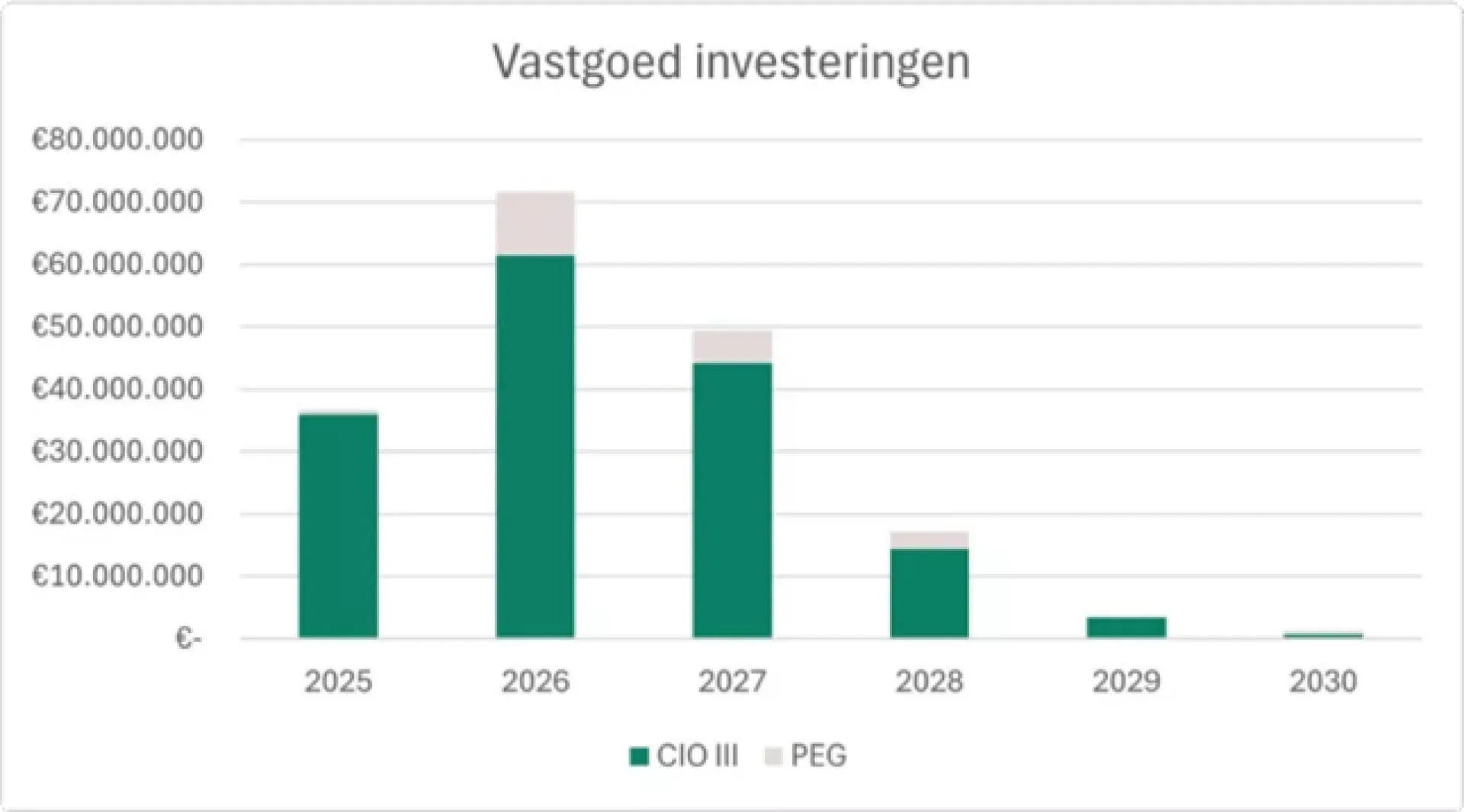
As explained in Chapter 6 (Operational Management), EUR aims to be one of the most sustainable universities in the Netherlands. The ongoing development of the campus through the Campus in Development (CIO) project is contributing to the university’s international appeal, a stimulating learning and working environment and a sustainable campus. The renovation of the Tinbergen Building is an important part of these sustainability efforts. This project received an internationally recognised rating for our commitment to sustainability and environmentally friendly construction. The renovations include the installation of double glazing, solar panels and energy-efficient building systems. This has led to a more efficient use of energy and a reduction in our carbon footprint. These sustainability efforts involve higher investments than previously estimated. Between now and 2030, we expect to invest €180 million. We expect to finance the renovations partly from our own resources and partly through treasury banking. In addition, wage and price rises in recent years are putting increasing financial pressure on CIO projects.
Labour market and price developments
As in previous years, we expect shortages of both construction materials and personnel in 2025 and beyond. This fact, combined with the amount of work to be done, is making contractors averse to risk when submitting a tender. This decreases the chances of finding multiple suitable contractors, and competition is not working for us as it has in the past. All of this could lead to an increase in construction costs and delays in the schedule.
Energy costs seem to be stabilising, although geopolitical developments are creating ongoing uncertainty. A focus on managing energy consumption on campus is essential. The opening hours of the buildings and the patterns of use play a major role here, as does improving the efficiency of building use.
In 2025, the focus will be on achieving the objectives set out in the Buildings Energy Transition Portfolio Roadmap (Portefeuilleroutekaart Energietransitie Gebouwen, PEG), which centre around energy-saving measures. With these energy-saving measures, the university is working towards becoming ‘Paris Proof’ by 2030. We have also drawn up a long-term energy management vision, which will contribute to further optimising our energy consumption.
Absorbing the additional costs of the Tinbergen Building
In the middle of Campus Woudestein stands the Tinbergen Building, a municipal listed building that has been in use since 1968. Most of this building’s technical systems are past the end of their useful life and no longer comply with current legislation. The Tinbergen Building will therefore be renovated over the next few years. Given market developments, the total investment cost will be substantially higher than was estimated a few years ago. To pay for the additional cost, opportunities for savings have been explored and strictly incorporated into the real estate budget.
IT investments
IT investments
Security and privacy are important, for example due to the intensification of cooperative arrangements
Collaboration, knowledge sharing and a secure digital environment are crucial to achieving EUR’s strategic goals. In ‘The State of Digitalisation’, EUR identified relevant developments around digitalisation both within and outside the university. The resulting digitalisation roadmap will guide improvements in the digitalisation of education, research and operational management. Major projects will demand a great deal from the organisation in the coming years. This could include a new system to support PPM-Research, replacement of the operational management system and developments in areas such as AI and data.
Overall, between now and 2027, a great deal of attention will be paid to the maturity of processes and systems in terms of security, privacy, information management and continuity. Efforts to standardise and harmonise IT processes will also play an important role in the period 2025–2027. This will promote efficiency, cost control and sustainability and lead to a reduction of risks within the information landscape.
IT costs over the long-term, 2025–2028
For 2026 and beyond, there will be budgetary challenges due to the maintenance and replacement of audiovisual equipment, network costs, and the decrease in the government grant for cyber resilience. On the IT front, measures will be taken to cut costs. This will be done in compliance with guidelines and priorities.
€8 million per year is being budgeted to update the information provision systems.
EUR’s current IT organisation is primarily set up to ensure continuity of internal services and provide tailored solutions. The biggest challenge is responding faster and more effectively to change, putting the customer first and being sensitive to what is happening in the environment. The Transformation Project should make the IT organisation more agile.
Long-term budget
The long-term budget takes into account developments affecting the university as much as possible. The impact of the Balanced Internationalisation Act has not yet been incorporated into the long-term budget, due to all the uncertainties.
For 2025, EUR expects a loss of €4.3 million. This result includes the results of related parties but excludes the negative result of €6.4 million for FGG/EMC. For 2026, 2027 and 2029, the university has set itself a major challenge of achieving a structurally balanced budget. The specific measures that will be used to achieve this goal have not yet been identified. For 2028, EUR expects a positive result due to the planned sale of properties. The notes below provide details on the long-term balance sheet and income and expenditure.
Trends and developments
Long-term budget
Long-term balance sheet
table 28
| 2024 | Budget 2025 | Planning 2026 | Planning 2027 | Planning 2028 | Planning 2029 | |
|---|---|---|---|---|---|---|
| Assets | ||||||
| Fixed assets | ||||||
| Intangible fixed assets | 1,8 | 13,8 | 12,6 | 11,4 | 10,3 | 9,3 |
| Tangible fixed assets | 289,6 | 284,6 | 320,5 | 339,0 | 323,4 | 282,8 |
| Financial fixed assets | 6,3 | 1,5 | 1,5 | 1,5 | 1,5 | 1,5 |
| Total fixed assets | 297,7 | 300,0 | 334,6 | 351,9 | 335,2 | 293,6 |
| Current assets | ||||||
| Inventories | 0,0 | 0,0 | 0,0 | 0,0 | 0,0 | 0,0 |
| Receivables from tuition fees | 0,6 | 0,0 | 0,0 | 0,0 | 0,0 | 0,0 |
| Other receivables | 63,1 | 39,1 | 39,4 | 39,8 | 41,7 | 40,4 |
| Cas and cash equivalents | 164,2 | 160,2 | 122,5 | 119,4 | 131,8 | 171,8 |
| Total current assets | 227,9 | 199,4 | 161,9 | 159,2 | 173,5 | 212,2 |
| Total assets | 525,6 | 499,3 | 496,5 | 511,1 | 508,7 | 505,8 |
| Liabilities | ||||||
| Equity | 207,5 | 206,8 | 206,8 | 206,8 | 209,8 | 209,8 |
| Provisions | 34,5 | 28,6 | 26,0 | 26,0 | 26,0 | 26,0 |
| Non-current liabilities | 7,0 | 6,7 | 24,1 | 60,5 | 56,8 | 53,0 |
| Current liabilities | 276,6 | 257,3 | 239,7 | 217,8 | 216,2 | 217,1 |
| Total liabilities | 525,6 | 499,4 | 496,5 | 511,1 | 508,8 | 505,9 |
Notes to the long-term balance sheet
The fixed assets will increase due to investments in accommodation, including the CIO project and the Tinbergen Building, and in IT, including the new operational management system for Finance and HR. In 2028, the book value of the tangible fixed assets will decrease, due to the planned sale of properties. These movements in the real estate portfolio will have a direct impact on the liquidity position of the university. From 2025, the total of cash and cash equivalents will decline, mainly due to the financing of real estate projects such as the Tinbergen Building renovations.
Further details of the financing requirements will be prepared in 2025. The long-term balance sheet takes into account the allocation of treasury financing for real estate investments of €20 million and €40 million in 2026 and 2027 respectively. This will increase the long-term debt.
The discontinuation of the starter and incentive grants will reduce the balance sheet position of the current liabilities. On the other hand, an increase is expected in tuition fees received in advance, caused by the increase in the institution tuition fee rate for non-EEA students and the aforementioned change in the ratio of EEA students to non-EEA students. As indicated earlier, the expected effects of the Balanced Internationalisation Act have not yet been included in the long-term budget, as we are unable to reliably estimate them. The student numbers presented and the associated revenues are likely higher than they will be in reality upon the introduction of the Balanced Internationalisation Act.
Income and Expenditure
table 29
| in € million | Actuals 2024 | Begroting 2024 | Planning 2025 | Planning 2026 | Planning 2027 | Planning 2028 | Planning 2029 |
|---|---|---|---|---|---|---|---|
| Central government grant | 455,5 | 457,2 | 470,4 | 468,8 | 465,0 | 461,8 | 461,8 |
| Tuition fees | 87,5 | 88,9 | 96,0 | 101,3 | 101,5 | 102,0 | 102,0 |
| Income from work commissioned by third parties | 244,7 | 247,2 | 243,9 | 246,0 | 249,7 | 253,3 | 253,3 |
| Other income | 118,1 | 122,7 | 130,9 | 130,6 | 130,3 | 146,1 | 132,7 |
| Total income | 905,8 | 916,0 | 941,3 | 946,8 | 946,6 | 963,2 | 949,8 |
| Personnel expenses of staff on payroll | 617,2 | 628,8 | 645,0 | 643,8 | 640,3 | 637,3 | 637,3 |
| Staff not on payroll | 34,8 | 31,1 | 25,7 | 27,8 | 28,9 | 30,0 | 30,0 |
| Depreciation | 42,2 | 42,8 | 39,9 | 39,7 | 43,2 | 45,1 | 43,9 |
| Accommodation costs | 43,8 | 46,5 | 45,2 | 45,6 | 50,0 | 47,9 | 47,9 |
| Other expenses | 195,7 | 187,4 | 192,4 | 189,6 | 188,8 | 190,0 | 190,0 |
| Total expenses | 933,7 | 936,6 | 948,3 | 946,5 | 951,2 | 950,4 | 949,1 |
| Net income (expense) | -27,9 | -20,6 | -7,0 | 0,2 | -4,6 | 12,8 | 0,7 |
| Financial income and expenditure | 10,8 | 2,7 | 6,0 | 2,5 | 2,5 | 2,5 | 2,5 |
| Taxes | 0,0 | 0,0 | 0,4 | 1,2 | 2,5 | 3,3 | 3,1 |
| Result for the year | -17,1 | -17,9 | -1,4 | 1,6 | -4,6 | 12,0 | 0,1 |
| Third-party share of result | -13,5 | 7,0 | 3,0 | 6,0 | 9,0 | 9,0 | 9,0 |
| Net result for the year | -3,6 | -24,9 | -4,3 | -4,4 | -13,6 | 3,0 | -8,9 |
| Target | 0,0 | 0,0 | 0,0 | 4,4 | 13,6 | 0,0 | 8,9 |
| Net result incl. target | -3,6 | -24,9 | -4,3 | -0,0 | -0,0 | 3,0 | -0,0 |
Notes on the long-term income and expenditure
In the long-term budget, a negative result is budgeted for in 2025. For 2026, 2027 and 2029, the express goal is to end the year with a neutral budget. A target has been included for this goal. This long-term budget for 2025–2029 shows an improvement over the long-term budget for 2024–2027. This is largely caused by announced budget cuts that are yet to be fully implemented. Examples of cuts that have been announced include the adjustment of the strategic budget (€3.5 million), detailing of the target for the service units (€5.8 million) and implementation of recovery plans by several faculties.
The positive result in 2028 will be caused by proceeds from the one-off sale of real estate that are yet to be realised.
The decline in the number of funded students and the discontinuation of the starter and incentive grants will lead to a drop in the central government grant. A new factor is the anticipated allocation from the Workload and Talent Policy scheme worth €9.3 million. It was not yet possible to incorporate the impact of the baseline estimate into the 2025–2029 budget. However, these details have been included in the 2026–2030 framework memorandum. We have estimated the impact on EUR’s percentage of market share based on preliminary national reference forecasts. However, the number of incoming students is more unpredictable than ever, due in part to the turbulence caused by the WIB. The question is whether the national decrease will affect each university in proportion to their market share. The expected decline in the number of students has caused a downward adjustment of tuition fees. If the tuition fee rates, especially the institution tuition fee rates, rise faster than expected, this decline will be partly offset.
The increase in ‘Income from work for third parties’ is caused by the expected growth in executive education provided by related parties. At EUR Woudestein, cautious estimates have been made for future years, leading to a drop in these revenues. The increase in other income in 2028 will be realised through the one-off sale of real estate.
Despite the increase in wage costs, staffing costs will remain the same in the period 2025–2029. The slight decline in 2027 is caused by an expected drop due to the decrease in projects, which will reduce the need for staff, including temporary staff. Hiring costs will also fall as a result of the cost-cutting measures.
Investments in buildings, inventory and equipment from completed projects and the Tinbergen Building and the new operational management system will increase depreciation and accommodation costs from 2027 onwards. The operating costs associated with the management and maintenance of investments and land will also rise.
In the period 2025–2028, depreciation will increase from €14.5 million to €19.4 million, mainly due to the implementation of CIO III (including the completion of the Sports Building and Langeveld Building). There will also be non-recurring demolition costs in 2027 and 2028, contributing to the increase in accommodation costs.
In 2025, the economic life of the university’s assets will be reviewed. This may affect asset depreciation periods. This will be a careful process, in which the benefits and risks will be identified. This reconsideration could lead to a lower operating budget and help absorb the additional costs of the Tinbergen Building renovations.
The lower interest income on our own funds and the higher interest costs involved in raising the treasury financing and other forms of financing for the renovation of the Tinbergen Building are reflected in the declining balance for financial income and expenditure.
The budgeted results for FGG/EMC are included under ‘Third-party share of the result’ and are not part of the EUR equity. To improve the negative result, a roadmap is being drawn up by FGG/EMC to remain financially sound.
Risk management and control system
Risk management and control system
In the pursuit of a solid and well-functioning organisation, EUR maintains a robust control framework. This framework is based on joint policy-making, anchored in EUR's broad strategy and supported by all stakeholders, including the Executive Board, deans, directors of support services and education and research directors. At the centre of this framework lies an interactive management philosophy, in which a decentralised management culture and integrated management of decentralised managers are essential, and which fits within the established frameworks of the Executive Board.
The internal control system incorporates various regulations and procedures designed to provide reasonable safeguards and to identify and control significant risks. This approach is further supported by a well-thought-out risk management policy and a robust risk and control framework. This involves determining risk appetite within the established university frameworks. This task is the responsibility of the Executive Board, which then submits its findings to the Supervisory Board. Risk appetite is not a given fact and, due to social developments, is subject to change. EUR subscribes to the Association of Universities in the Netherlands (Vereniging van Universiteiten in Nederland, VSNU) Code of Good Governance.
Risks and uncertainties
This risk section takes a closer look at the specific EUR-wide risks that may affect the financial and operational health of the university, as well as the measures taken to manage and mitigate these risks.
| Description of risk | Control measure |
|---|---|
| EUR’s financial future-proofing comes under pressure | |
| (Financial) | |
| Revenue is falling while costs are rising, resulting in financial shortfalls. The government is making substantial cuts to education and research funding. The Balanced Internationalisation Act is the measure with the most impact, which could (and probably will) cause entire degree programmes to disappear. In addition, our costs are rising due to wage and price increases, and these are no longer being automatically compensated for in our funding. Our costs are also rising due to necessary investments (including in buildings and IT). With structural financial deficits and without additional cost-cutting measures, the ability of EUR to continue as a going concern is at risk. EUR has two major vulnerabilities that are relevant: 1. Limited financial flexibility 2. Reliable financial management information To balance the long-term budget – before the impact of the aforementioned measures was incorporated – significant cost-cutting measures have already been taken. However, the aforementioned developments call for additional measures. Due to its cost structure (permanent staff, fixed capital costs etc.), EUR has limited room to manoeuvre on financial matters. In addition, the EUR does not have a good track record of delivering reliable financial information in a timely manner. This applies to both information about actual costs and revenue and information about projected costs and income. |
This risk should be mitigated by: 1. Devising and implementing additional measures that will prevent structural financial deficits. 2. Increasing the quality of financial management information, in terms of reliability, timeliness and frequency. This will be achieved through stricter monitoring of financial figures over time, including analysing scenarios. Specific measures will be linked to these scenarios and will be implemented as soon as certain situations arise. In addition, actual results and forecasts will be reported more frequently. Using a hard close at the end of financial periods, including monitoring compliance with agreements made, will improve management information, allowing for better and more timely management decisions. Financial uncertainties in reports will be reduced not only by looking at the short and long-term operating budgets, but also by looking more frequently at the expected impact on EUR’s liquidity position over the short, medium and long term. Controls: - Devising scenarios and the associated cost-cutting measures - Frequent management reporting and guidance - Execution of a hard close |
| Interdisciplinary potential | |
| (Education & research) | |
| A risk affecting both education and research, due to: -Increasing and complex societal challenges; -Increasing competition from other universities at home and abroad, including in the area of online and on-campus education at foreign universities. |
Using EUR’s strategic partnerships to achieve more effective collaboration in education and research between different universities and faculties, and ‘thinking and working’ as part of an ecosystem. In addition, we will put more focus on the sharing of information within these partnerships. One example is the Academic Collaborative Centre Insured Care. Risk management merits greater attention due to increasing competition and societal challenges. The control framework is being further developed. A focus on information sharing also entails further developing control measures around knowledge security. Controls: - Annual review of interdisciplinary programmes and reporting to the Executive Board - Specific KPIs for the number of interfaculty publications and projects - Implementation of mandatory data security checklist in interdisciplinary projects |
| Personnel & Wellbeing | |
| (Operational management, Personnel) | |
| Risk of high workload due to labour market shortages. This in turn is linked to the risk of not being able to meet and/or fulfil internal and external quality standards in the field of education and general remit. | The risk of high workloads will be reduced by: - Identifying future workforce challenges through strategic personnel planning and being an attractive employer by offering positive employment terms, career opportunities and a safe working environment. - Reviewing the current system of recognising and rewarding academics to ensure high educational standards, promote excellence in research, increase the impact on society, encourage inclusive leadership and, in the case of Erasmus MC, deliver excellent patient care. - Centrally coordinating and implementing an action plan to reduce workloads in a targeted way (partly in response to the visit by the Netherlands Labour Authority). Controls: - Annual staff satisfaction survey with a specific focus on workloads and central monitoring of the improvement plan, including agenda items in the regular consultation meetings between the management team of the organisational unit and the Executive Board. - Setting workload indicators for each faculty/service unit, with central monitoring. |
| Cyber security and information security | |
| (Operational Management, IT) | |
| Increasing digital dependence, rapid ICT developments in higher education and a growing threat of cyber attacks. EUR is implementing a new operational management system. According to the current schedule, the implementation date for the operational management system is 1 January 2026. | Erasmus Digitalisation & Information Services (EDIS) completed the EV3 programme in collaboration with the faculties and services, with the aim of being demonstrably in control at Maturity Level 3 with regard to a selection of 11 core central and faculty systems. Over the next few years, all remaining core applications will also be brought ‘in control’ at Maturity Level 3, as required by the Ministry of Education, Culture and Science. Based on current projections, this will take around four years. Safeguarding the current security level also requires and receives the necessary resources. In the context of cybersecurity risks, it should also be noted that the human factor is always a risk in practice and should not be underestimated. EUR has regulations on the action to be taken in the event of potential phishing. These regulations are shared widely within EUR in the context of job support. The regulations and procedures will be raised during regular meetings to maintain awareness. The ICT organisation has committed to mandatory cyber awareness training for all staff. For instance, security and privacy issues should become part of the onboarding programme. The successful attack on TU Eindhoven is a direct example of the need for adequate awareness among staff. During the inventory process (to identify the relevant IT functionality) for the new operational management system, appropriate IT control measures must also be taken into account in order to continue monitoring and addressing security risks in the different IT layers. The new IT platform will be another necessary step in the right direction to mitigate the increasing security risks. Controls: -Mandatory annual cyber awareness e-learning module, with a test. -Twice-yearly phishing simulation campaign with reports on participation and click rate -‘Security by design’ audit for all new IT projects before they go live. |
| IT dependency, including dependency on cloud suppliers (due to cloud migration) | |
| (Operational Management, IT) | |
| Greater dependency on suppliers leads to increased exposure of sensitive data and susceptibility to supply chain attacks (supply chain risk). Another consequence, which is specific to cloud migration (and dependency), is a reduced capacity to monitor suspicious and malicious traffic. | Risk-based Vendor Risk Management will be used to manage this risk. We are keeping a grip on chain risks through EUR-specific security frameworks, supplier relationships and monitoring. Over the coming years, this process will grow rapidly in maturity. A thorough risk analysis is necessary to determine whether, for example, a cloud-based attack detection and response solution can close the widening gap in monitoring capacity. The importance of protection at endpoints is also increasing, with Endpoint Detection & Response (EDR) providing a solution. Besides detecting and preventing attacks, there is an increasing risk of intended and unintended data leaks. With a Data Loss Prevention (DLP) solution, the organisation can reduce many of these risks. These kinds of solutions require a lot of effort and lead time for proper set-up. EUR is implementing a Cloud First strategy in line with the government’s ‘Implementation framework cloud use risk assessment’. Initial and ongoing risk assessments of supplier relationships, Big Tech dependency and geopolitical developments should lead to responsible management of IT strategy and service delivery. Controls: -Annual independent IT audit of suppliers (third-party SOC2 assurance report) -Cloud risk assessment for new services before contracting -Monthly monitoring reports on endpoint security |
| Artificial Intelligence | |
| (Operational Management, IT/Compliance) | |
| Developments in artificial intelligence are increasing risks such as plagiarism, fraud and privacy. See: Privacy and fraud risks. | Artificial intelligence is high on the agenda and ways in which it can be used in the learning and research process within EUR will be examined in the period ahead. Measures are being developed further as a priority. The use of plagiarism scanners on submitted digital documents mitigates the risk of plagiarism to a significant extent. Controls: -EUR-wide implementation of AI Code of Conduct and monitoring of compliance -Mandatory plagiarism checks -Training module on AI ethics for lecturers and researchers, including monitoring of compliance. |
| Privacy and fraud risks | |
| Operational Management (IT/Compliance) | |
| Inadequate control of privacy-sensitive information within the university poses a significant risk. This concerns both the protection of personal data and compliance with relevant privacy laws and regulations, such as the GDPR. Inadequate management can lead to data breaches, loss of confidentiality or non-compliance with privacy rules, which could be damaging to EUR’s reputation and could also have legal consequences. | Privacy policy and data classification: There is a clear privacy policy, in line with the GDPR, defining the procedures and guidelines to be followed. The policy includes a detailed data classification for all data processed, giving specific attention to the protection of sensitive and special personal data. Security and access: Access to privacy-sensitive information is strictly controlled through authentication, authorisation and the principle of ‘least privilege’. This means that only authorised persons have access to the data strictly necessary for their job. •Multi-factor authentication (MFA) is mandatory for systems containing personal data. •Access logs and monitoring are maintained and analysed to detect unauthorised access or data breaches early. Privacy by design and by default: All new IT and other systems and processes within EUR are designed with privacy protection as a basic principle. This includes ensuring the privacy of the data subject from the outset, for example by minimising data processing and anonymising data where possible. |
| Real Estate & Facilities | |
| Operational management (Accommodation/Financial) | |
| Fluctuations in student numbers, online teaching and hybrid working could lead to changing accommodation needs with the risk of suboptimal supply/demand ratios (and unnecessary higher costs or missed savings); -Higher prices and lower availability of materials and services have a direct impact on all activities relating to real estate. The expected investment expenditure is also a source of uncertainty; -Lack of or delayed embedding of sustainability in accommodation. |
-Accomodation needs are identified as part of ongoing investment programmes (for example as part of Campus in Development III/IV) so that appropriate measures can be taken. The ‘Real Estate & Facilities’ department monitors progress on these investment programmes, including expectations for the future, and explicitly takes into account the changes in student numbers. -Price movements are monitored and measures are taken where possible/necessary. As part of the investment programmes, indexation is consistently calculated for the various real estate projects. The expected financial impact is determined so that adjustments can be made accordingly (indexing against the construction cost data (BDB) one-year-ahead index and EUR averages > 1 year); -More frequent forecasts will be made, incorporating the expected effects on the EUR’s medium-to-long-term liquidity position. Timely anticipation of identified financing needs; -EUR is taking measures to make progress in improving the sustainability of its buildings and grounds. These measures are reflected in the investments in new and existing buildings and land owned by EUR and are part of the ‘Campus in Development’ strategic accommodation plan. Controls (summary): - Twice-yearly updating of the accommodation plan - Sustainability: annual campus CO2-reduction report - Monthly progress report on investment projects to project board. |
| Quality support services Operational Management | |
| (Accommodation, IT and Personnel) | |
| The increase in the number of students in recent years (this is independent of the forecast decrease in the number of students) combined with hybrid education creates challenges for maintaining the quality of basic support services. | EUR is faced with the task of reassessing, prioritising and potentially adjusting the delivery of services. Measures are being developed further as a priority. Controls: -Regular benchmarking of support services against peer universities. -Regular alignment of service provision with the primary process (faculties), and adjusting the product-service catalogue on this basis. -Formulating specific service standards and measuring them annually (e.g. ICT help desk response time). |
| Capacity for change | |
| (Operational Management) | |
| Risk that the university is insufficiently able to implement innovations in education (interdisciplinary/impact-driven). | Recognise and implement the required basic conditions, such as infrastructure for innovation in education (not just digitalisation). Reduce barriers that can potentially hinder innovation of certainties. Controls: -Annual innovation report setting out initiatives implemented and lessons learned. -Concrete investment calendar for educational innovation, coordinated with the Executive Board (including spending of the innovation budget, known internally as the PPB). |
| Reputational damage | |
| (Other risks, strategic or otherwise) | |
| Failure to effectively manage risks in relation to aspects such as fraud, conflicts of interest, ESG sustainability in general and social protests. | EUR is aware of its social function and always strives for an open dialogue, based on equality, with its environment. In the context of the ongoing development of its sustainability strategy, EUR holds climate dialogues to obtain information on new standards for sustainability at EUR. The outcomes of these dialogues make a valuable contribution to EUR’s sustainability strategy with regard to its education, research and operational management. In the coming years, sustainability targets, related KPIs and risk measures will be further enshrined in the operational management. Controls: -Annual sustainability reporting to be developed further in the coming period (ESG Proof is the ambition) -Structural societal dialogue: at least one stakeholder session per year. |
| Governance and leadership | |
| (Other risks, strategic or otherwise) | |
| Organisational management, collaboration between service units and faculties, the number of initiatives, alignment of the EUR strategy with the strategy of the organisational units, insufficiently comprehensive terms of reference and division of tasks and responsibilities within EUR. | In 2025, the organisation will work on strengthening the focus and governance of the strategy and collaboration between the various organisational units. A panel will perform an interim review of the strategy and make recommendations. Among other things, this review will show where the future focus should lie, to ensure the continued implementation of the EUR strategy throughout the university. This will involve making a variety of choices, including about what should no longer be done, taking into account the available resources. Consultation with various stakeholders will result in concrete proposals for improvements for follow-up actions, including the need to maintain a clear focus on the strategic ambitions of culture and leadership, in addition to impact and sustainability. Interaction between the Executive Board and the deans is essential for delivering on these choices. The EUR leadership programme contributes to this. Controls: -Twice-yearly review of progress in implementing the strategy, by faculty/service unit -Leadership programme: annual participation rate and evaluation of effectiveness. |
| Geopolitical developments | |
| (Other risks, strategic or otherwise) | |
| In the current geopolitical climate, universities like EUR face various risks arising from international tensions and developments, such as: -Disinformation: The spreading of false information about the university, research or policy, resulting in reputational damage. -Polarisation: An increase in tensions within the academic community, putting pressure on collaboration and academic freedom. There has also been a noted radicalisation of views within groups of students and staff. -Protests: An increase in the duration and intensity of protests that could disrupt the university’s operations and distort its image. |
-Creating awareness among staff and students, by educating them on how to recognise disinformation. -Active monitoring and fact-checking of reports and posts about the university and responding in a timely manner with accurate information. -To counter polarisation, open and respectful discussions are encouraged, to increase mutual understanding. Neutral and inclusive communication will also be used to try to avoid unintentionally excluding certain groups or reinforcing polarisation. -Academics may have to deal with outside intimidation or threats because of their research. It is important to set up protocols and support systems to ensure the safety and wellbeing of employees. Initiatives such as Secure Science (WetenschapVeilig) provide a platform for reporting and handling such incidents. -Establishing clear guidelines on where and how protests are allowed to take place. Engage with protesters at an early stage to prevent escalation and provide space for peaceful protest. |
| Public/private | |
| (Compliance) | |
| Compliance risk due to investing public funds in private activities and increasing complexity in laws and regulations. | EUR has drawn up a draft policy document that explains the guidelines for implementing and applying the policy rules. This document provides a framework for measures to be taken in relation to investing public funds in private activities. To a large extent, material risks are currently addressed by understanding relevant transactional data flows (as recorded in the administrative systems) and monitoring them using the policies described. This then results in reporting and accountability in accordance with applicable policies. However, there are still many ambiguities and areas of ongoing discussion with the Ministry of Education, Culture and Science around the policy rules. Preventative measures will be developed further in collaboration with the various organisational disciplines and units. For example, current external contractual relationships will be reviewed and internal organisational units/relationships simplified where necessary and further aligned with the requirements and increasing complexity of public investment in private activities. As part of the new operational management system, there will also be more focus in this context on the increasing availability of data to achieve efficient and timely monitoring of public/private funds. |
| Knowledge security | |
| (Security risks) | |
| The unwanted transfer of knowledge (particularly sensitive knowledge), with negative consequences for national security and a detrimental impact on Dutch innovative strength, covert influence on our education and research by state actors, resulting in forms of censorship (including self-censorship), thus affecting academic freedom and, finally, ethical issues related to collaboration with persons/institutions with a negative impact on EUR. | Creating greater awareness and designing knowledge security risk assessments in a more efficient way, resulting in a mitigation plan. Specifically, we want to do this by: 1.Drafting a broadly supported assessment framework for knowledge security, applicable to all faculties and service units (with input from all faculties/service units, at multiple levels in both the administrative and operational spheres). 2.Establishing a risk-based approach, which, based on indexing of risk profiles, can be used to create a standard minimum mitigation plan. |
| Business Continuity Management | |
| (Security risks) | |
| A combination of the current technological, geopolitical and societal developments makes giving attention to business continuity management (BCM) increasingly urgent. After all, there is a risk of serious disruptions to teaching, research and operations in the event of a cyber attack, power cut, pandemic or physical damage to buildings, among other emergencies. The consequences could include reputational damage, financial loss, legal liability and loss of trust among students, staff and external partners. | IIn the past two years, a good foundation has been laid for the implementation of business continuity management (BCM). In 2025, a permanent position will be established for the coordination of this theme, centrally positioned within the General Management Directorate (ABD), which is expected to further strengthen the continuity, central coordination and effectiveness of BCM. This will contribute to structural and sustainable assurance of business continuity within EUR. Controls: - Annual BCM exercise for critical processes - BCM plans ready and updated annually for all faculties and service units |
Compliance
Compliance with the Treasury Statute
The purpose of the Treasury Statute is to establish a framework within which EUR's treasury activities should take place. This involves establishing the principles, objectives, guidelines and limits for the implementation of the treasury function in the form of policy. The Treasury Statute is also designed to reflect the administrative organisation and internal control in relation to the treasury activities in order to manage EUR’s financial resources efficiently and effectively.
The Treasury Statute defines the areas of responsibility of the treasury function. The treasury function has the primary aim of managing financial risks and includes the following areas of responsibility within EUR:
- Liquidity management: ensuring the timely availability of the necessary cash in the short, medium and long term, on acceptable terms (availability).
- Management of interest rate risk: optimising returns on surplus cash and cash equivalents within the frameworks of the Treasury Statute (interest rate optimisation).
- External financing: raising loan capital and minimising the costs of loans (cost minimisation).
- Financing: providing loans, grants and security to related parties and non-consolidated institutions, in the context of performing the statutory task, while minimising financial risk (risk minimisation).
- Maintaining banking relationships: maintaining relationships with financial institutions with a view to the availability of financial resources and optimal conditions (banking relationships).
The Treasury Statute complies with the OC&W Regulation on Investing, Borrowing and Derivatives 2016 (Regeling beleggen, lenen en derivaten van het Ministerie van OCW 2016). The Treasury Statute was updated in 2023. The main change concerned the relationship with related parties in terms of liquidity management and financing. The transactions that took place in 2023 were in line with our university's Treasury Statute. EUR uses treasury banking, in which excess liquid funds are held by the Ministry of Finance.
The university has no investments.
Reporting on expenses claimed by Executive Board members for 2024
In accordance with Article 4(3) of the Regulation on Annual Reporting in Education (Regeling Jaarverslaggeving Onderwijs, RJO), remuneration to and expenses claimed by members of the Executive Board in 2024 are reported in the table below. Amounts are in euros.
table 30
| prof. dr. A.L. Bredenoord | dr. E.M.A. van Schoten RA | prof. dr.ir. J. Schuit | prof. dr. H. Brinksma | |
|---|---|---|---|---|
| Expense allowance | 7.071,00 | 6.496,32 | 1.370,06 | 13.330,88 |
| Travel expenses (domestic) | 11.974,69 | 12.680,45 | 1.517,71 | 10.705,49 |
| Travel expenses (international) | 8.425,54 | 529,68 | 208,80 | 248,16 |
| Other costs | 13.341,75 | 2.881,78 | 0,00 | 32,18 |
| Total | 40.812,98 | 22.588,23 | 3.096,57 | 24.316,71 |
Policy Rule on Investment of Public Funds in Private Activities
General principles
The following basic principles were used to prepare the report under the policy rule ‘Investing public funds in private activities’ (Investeren met publieke middelen in private activiteiten) (“the Policy Rule”):
- At all times, the EUR wishes to prevent public funds from leaking into the private domain and/or being used to compete unfairly with third parties. With regard to its private activities, EUR wishes to report on them in a clear and transparent way in this annual report.
- The focus of EUR’s private activities is on making a positive societal impact. If EUR uses public funds to invest in private activities, that investment will add value to the university’s statutory task.
- In his letter of 16 December 2024 (reference number 49447179), the Minister of Education, Culture and Science identified certain activities that will be exempt from the legality check for the 2024 reporting year, as well as the loosening of certain requirements regarding the way institutions have to report that will apply for the 2024 reporting year. These temporary exemptions were taken into account in the preparation of the 2024 report. For the sake of completeness, it is hereby noted that the report was prepared on the basis of the non-consolidated statement of income and expenditure (i.e. excluding the related parties).
- In his letter, the Minister also identified a number of issues for which further investigation is needed, such as valorisation and lifelong learning (LLO) activities. EUR is monitoring developments on these issues, and in the meantime, despite the various uncertainties, aims to comply as closely as possible with the intentions of the policy rule.
- EUR has internally prepared a draft policy document and developed an integrated cost model. These documents will be finalised in 2025, and will thereafter be used as guidance throughout the EUR in issues concerning the investment of public funds in private activities.
Private activities in which public funds are invested
Some of EUR’s activities are covered by the policy rule. Below, we report on the investment of public funds in private activities by category.
Contract education
Almost all of EUR’s non-funded educational activities are carried out by related parties, mainly the operating companies EUR Holding BV and RSM BV. Within EUR’s faculties and service units, private educational activities take place only on a limited scale, with a total value of €3.0 million.
A substantial portion of this amount relates to the Language and Training Centre (LTC), which offers a wide range of language and other courses. These are primarily aimed at EUR students and staff, but are also open to third parties. Offering such courses enables EUR students and staff to make a high-quality, positive contribution to EUR’s funded education and research, as well as to the rest of society. In the 2024 calendar year, the LTC generated income of €1.2 million and achieved a positive result of €0.4 million.
The LTC was therefore able to cover its costs.
The LTC is legally and organisationally embedded within EUR’s central organisation and comes under the responsibility of the Directorate of Education & Student Affairs. Day-to-day management is performed by the LTC director. The LTC acts in accordance with the EUR-wide risk management policy and follows the internal guidelines regarding legality. Financial assessments of cost recovery and prevention of unauthorised cross-financing are carried out in cooperation with Concern Control and the Legal Affairs Department.
Other contract education (€1.8 million in total) consists of a variety of educational activities, most of which generate less than €50,000 in revenue. For these activities, the faculties and service units do not currently keep separate records, partly because of the administrative burden. As a result, it is not possible at the moment to accurately determine the extent to which these activities cover costs. In 2025, we will explore better ways to distinguish between public and private activities in EUR’s new operational management system, and how to better understand the risks and returns of private activities. The new operational management system is expected to be implemented in 2026.
For the sake of completeness, we note that the International Institute of Social Studies (ISS) realised an amount of €2.3 million in income from its education. ISS is an EUR institute that provides education and research worldwide. The education provided by ISS includes two accredited Master’s programmes, which are mainly aimed at students from developing countries. ISS receives funding to carry out its education and research from the Ministry of Foreign Affairs, among other sources. The funding from the Ministry of Foreign Affairs is paid as part of EUR’s central government grant; EUR then passes it on directly to ISS. Accordingly, EUR considers the education provided by ISS to be part of its statutory task.
For contract education provided within a faculty or service unit, the dean or service unit director is ultimately responsible. The risks in this context include quality assurance, alignment with standard education and compliance with competition and funding regulations. Risk management measures are taken through the new operational management system, through central and decentralised contract checks (known as ‘FLAT’ checks) and through periodic internal assessments within the planning and control cycle. In addition, the EUR Regulations on the Disputes Board for Non-Initial Education 2023, which provide details on how EUR deals with disputes, apply to the university’s contract education.
Contract research
A variety of research projects are carried out within EUR for government agencies and the business community. The results of these research projects are usually accessible to a wide audience. This is how EUR transfers academic knowledge for the benefit of society. EUR therefore considers these research activities to be part of its valorisation task. However, there is still uncertainty about this within the Ministry of Education, Culture and Science. The Ministry has announced that a separate survey concerning this type of research will be conducted in 2025. In anticipation of this survey, EUR will continue to carry out research projects of societal interest in 2025, provided they fit within the university’s existing policy frameworks.
Whether a project is public or private in nature is recorded in the project administration. Based on internal analysis, it appears that only a limited proportion of research projects ought to be classified as private activities. These projects account for around €4.1 million in income. The profits from contract research flow back to the university and are used to conduct follow-up research, among other things. The positive result from private contract research was around €0.4 million in 2024 (based on completed research projects).
EUR’s policy dictates that the full cost (at a minimum) of private contract research must be passed on, thus limiting the risk of leakage of public funds and avoiding unfair competition. In determining the full cost, a risk premium is applied, which is equal to the capital market interest rate as at 1 January of the current year.
Contract research is legally and organisationally embedded within EUR’s regular research structure. For contract research conducted within a faculty, the dean is ultimately responsible. The project leader is operationally responsible and oversees the substantive execution and budget monitoring. Contract research risks mainly relate to reputation, independence, integrity and financial viability. These risks are managed through various measures, including:
- Sector codes of conduct such as the Netherlands Code of Conduct for Research Integrity.
- Internal policy on intellectual property, publication rights and interactions with clients.
The FLAT check procedure, which involves checking agreements for legal, financial and integrity risks, depending on the financial volume.
Leases
Total income from leases in 2024 amounted to over €9.6 million, including income from the car park and charging-on of service charges. A significant part of this income (€6.4 million) came from letting space to organisations affiliated with EUR. By providing accommodation to related parties, EUR supports initiatives in areas such as Lifelong Learning (LLO), entrepreneurship and valorisation. In doing so, EUR and its related parties make a positive contribution to society.
The remaining portion of the lease income (€3.2 million) mainly concerns space let to commercial parties (operators). Letting space to operators contributes to the vibrancy of the campus and enhances social cohesion and the wellbeing of students and staff. In addition, it creates opportunities for collaboration and cross-fertilisation with external partners.
EUR’s rental rates are based on an integrated cost model and are therefore cost neutral. Service charges are also passed on in full. This ensures, in line with the policy rule, that no public funds flow into the private domain.
The Real Estate & Facilities (RE&F) service unit is responsible for the entire leasing process, including pricing and contract management. The risks associated with leasing activities include liability, safety, legal risks and reputation. To manage these risks, EUR uses:
- The Buildings, Grounds and Facilities Order 2024, which provides frameworks for leasing and use;
- Standard lease agreements and general terms and conditions, which include explicit provisions on liability and terms of use;
- Active monitoring of the letting process and the use of campus facilities, so that any issues are identified and resolved in a timely manner.
Finally, new and non-standard letting activities are tested using the FLAT check procedure for compliance with relevant laws and regulations, including State aid rules.
Secondment
In certain situations EUR seconds its employees to its affiliates, and to a lesser extent to other universities and institutions. Secondments contribute to the quality of EUR’s statutory tasks: employees enrich their expertise through temporary deployment in another environment and bring the knowledge they have gained back to the organisation. Moreover, secondments strengthen employees’ academic and professional networks and promote interaction between theory and practice. Although the content and objectives of secondments may differ, generally speaking, all secondments are aligned with EUR’s public-interest task. This complies with the frameworks in the policy rule.
In 2024, private income from secondments amounted to €4.9 million. A significant part of this income (€3.6 million) concerned secondments from faculties to EUR-related parties. The remaining part (€1.3 million) related to secondments to third parties. As a rule, EUR charges the full cost (at a minimum) for secondments, so there is no direct or indirect subsidising of third parties with public funds.
Secondments are formally recorded in a secondment agreement with the receiving party. The employee’s manager assesses the content and purpose of the secondment, and formal approval is then obtained from the dean or service unit director. The Human Resources (HR) and Legal Affairs (JZ) departments provide support for the establishment of secondments (including adapting the terms of employment and drafting agreements).
In 2025, the standard secondment agreements will be updated, based in part on the requirements of the policy rule. Among other things, the revision will address risks relating to terms of employment, conflicts of interest and reputation. The use of standardised legal documents and the close involvement of the Human Resources and Legal Affairs departments will ensure that these risks are adequately managed.
Other activities
‘Other activities’ includes services to related parties and other services with a strong connection to EUR’s statutory tasks. The total income from other activities amounted to around €5.0 million in 2024. The result from these services is accounted for within EUR’s public equity. Based on sampling, it was found that EUR performs these activities in a way that their costs are covered, in line with the policy rule. This prevents the leakage of public funds into the private domain and unfair competition.
The ultimate responsibility for implementing and controlling these activities lies with the dean or service unit director of the faculty or service unit concerned. They ensure that the activities fit within the public framework and comply with internal policies and external regulations. Support services, such as Legal Affairs, Concern Control and Procurement, check for relevant legal, financial and organisational risks.
The Executive Board monitors the implementation and control of these activities through interim reports, audits and administrative consultation. In this way, compliance with policy frameworks is structurally monitored and adjustments are made where necessary.
Valorisation
In accordance with Section 1.3 of the Higher Education and Research Act (Wet op het Hoger Onderwijs en Wetenschappelijk Onderzoek, WHW), EUR sees its valorisation activities as part of its statutory duties and therefore also as public activities. However, because of the lack of clarity around which valorisation activities should be regarded as private, and for the sake of transparent reporting, valorisation activities will be reported on separately for 2024.
The income generated by EUR’s valorisation activities amounted to around €1.2 million. This included income from regional and other partnerships. Convergence and Culture & Campus are good examples of partnerships that make a significant contribution to solving societal issues. Another example of a valuable valorisation activity is the facilitation of academic conferences. These conferences are usually open to a wide audience and are organised on a non-profit basis. The main objective of such conferences is the exchange of academic knowledge. Since EUR considers such activities to be public activities, the conditions in the policy rule are not always observed. In particular, it is unclear whether the full cost is always passed on.
EUR also considers the activities of Erasmus Enterprise to be valorisation activities. A separate paragraph is devoted to these activities at the end of this chapter.
The responsibility for implementing and controlling valorisation activities lies primarily with the faculties and service units where the activities take place. The dean or service unit director is therefore ultimately responsible. The legal, financial and organisational risks are reviewed and managed by various support services.
In addition, the Executive Board monitors compliance and effectiveness of existing policies through interim reports, audits and administrative consultation.
Activities within related parties
We report below on investments made by EUR with public funds in the activities of related parties.
Erasmus Sport Foundation
EUR contributes to the wellbeing of students and staff by providing sports facilities and other initiatives. In doing so, EUR aims to promote an inspiring learning and working environment. These facilities are managed by the Erasmus Sport Foundation. EUR classifies these activities under its statutory task, which means that, in principle, no reporting on these activities is required under the policy rule. However, EUR chooses to do so in the interests of transparency. EUR provided a contribution of €1.5 million in 2024. The result of Erasmus Sport Foundation for the 2024 calendar year was negative €0.1 million.
Erasmus Sport Foundation is responsible for operating the sports building on the EUR campus. The foundation operates as an independent organisation with its own board. The foundation’s Articles of Association stipulate that board members must be appointed by EUR’s Executive Board. This ensures that the university is formally involved, without exercising direct supervision. The foundation requires approval from the EUR Executive Board to amend its Articles of Association. In accordance with agreements made, regular reporting and board-level meetings take place between EUR and the Erasmus Sport Foundation.
Erasmus Enterprise BV
EUR carries out a variety of valorisation activities through Erasmus Enterprise BV (EE). For example, EE encourages entrepreneurship among EUR students and staff. Furthermore, EE helps students and staff to use the knowledge gained from education and research to develop concrete products and services. EE creates an infrastructure/ecosystem that gives startups (founded by EUR students and staff) access to resources, networks and expertise, allowing knowledge to be efficiently transformed into tangible products and services. Bringing academics, students and third parties together encourages knowledge sharing and co-creation (a core aspect of valorisation).
The activities of Erasmus Enterprise can be considered valorisation because they connect academic knowledge with practical applications that create societal value, without market distortion. This means EE’s activities fall within EUR’s statutory task. For the sake of completeness and transparent reporting, the contribution from the EUR to EE in 2024 was €1.7 million, intended exclusively for the implementation of valorisation activities. EE BV realised a result of negative €0.9 million for the 2024 calendar year.
The director under the Articles of Association of Erasmus Enterprise BV is responsible for day-to-day management. Within regard to Erasmus Enterprise, the main risks are financial, legal and strategic in nature. EUR manages the risks related to Erasmus Enterprise through a clear governance and reporting structure and various financial and legal control mechanisms.
EUR Holding BV
Several operating companies operate under the umbrella of EUR Holding BV. They are mainly engaged in post-graduate education, research commissioned by third parties and the provision of consultancy services. In 2024, the holding company achieved a net revenue of €34.6 million.
RSM BV
The principal activity of RSM BV is the provision of executive and post-graduate education. In 2024, RSM BV’s operations generated revenue of €24.0 million.
Summary
Below is an overview of the amounts for the different types of private activities carried out at EUR in 2024.
table 31
| Private | Private | Estimate of investment of public | Estimate of |
|---|---|---|---|
| activities | income* | cash equivalents | result |
| Contract Education | €3.0 | €3.0 | € - |
| Contract research | €4.1 | €3.7 | +/+ €0.4 |
| Leases | €9.6 | €9.4 | +/+ €0.2 |
| Secondment | €4.9 | €4.9 | € - |
| Other activities | €5.0 | €5.0 | € - |
| Valorisation | €1.2 | Unknown | Unknown |
Overview including amounts for 2023.
| Private | Private | Estimate of investment of public | Estimate of |
|---|---|---|---|
| activities | income | cash equivalents | result |
| Contract Education | €5.7 | €5.7 | € - |
| Contract research | €8.0 | €7.3 | +/+ €0.7 |
| Leases | €17.6 | €15.9 | +/+ €1.7 |
| Secondment | €10.2 | €9.9 | +/+ €0.3 |
| Other activities | €7.8 | €7.8 | € - |
| Valorisation | €1.2 | Unknown | Unknown |
Activities for which there is no income in principle.
| Financial contribution | Financial contribution | Cumulative contribution from | |
|---|---|---|---|
| 2024 | 2023 | EUR | |
| Other party | |||
| Erasmus | |||
| Sport Foundation | €1.5 | €1.5 | €3.0 |
| Erasmus Enterprise BV | €1.7 | €1.7 | €3.4 |
Clarity Memorandum
The purpose of the 2003 Clarity in the Funding of Education Memorandum (Notitie Helderheid in de bekostiging van het onderwijs) and the 2004 supplementary memorandum is to provide clarity to publicly funded universities and universities of applied sciences on the interpretation and application of the existing funding rules for the computation of the funding parameters as of 1 October 2023 and for subsequent years. These memorandums cover nine themes.
Explanation of the themes, focusing on the situation in EUR at the end of 2024
1. Outsourcing of education At EUR, government-funded education is provided by the faculties in collaboration with EUR-related parties (private organisations). In return for the education provided, there is a fee for initial Bachelor’s and Master’s programmes.
The Erasmus School of Economics (ESE) outsources a limited part of its curriculum to FEI BV and Erasmus UPT. This relates to specific topics. The faculty remains responsible for educational quality. FEI BV and Erasmus UPT charge fees for this education.
The Erasmus School of Philosophy (ESPhil) outsources a limited part of its curriculum to the Dutch Research Institute for Transitions (DRIFT) BV and the Master’s in Societal Transitions offered by the Institute for Housing and Urban Development Studies (IHS). The faculty remains responsible for educational quality. DRIFT will charge for this education from 2025.
The Erasmus School of Social and Behavioural Sciences (ESSB) outsources a limited part of its curriculum to IHS BV (Master’s in Urban Governance).
2. Investment of public funds in private activities This topic has been replaced by the ‘Policy rule on investing public funds in private activities’. A separate section is dedicated to this topic in the management report.
3. Granting of exemptions EUR does not grant exemptions to students for the sole purpose of attracting students and thus increasing the central government grant without students making a commensurate effort in return. In order to qualify for an exemption, this effort must be established by the Examining Board.
4. Funding for international students Only students whose name and address details are known to EUR and who meet the funding requirements are counted for funding purposes.
5. Tuition fees not paid by students and the Profiling Fund EUR does not pay tuition fees for students. Profiling Fund schemes provide financial compensation for study delays due to personal circumstances, grants for participating in board activities and fee waivers. Appendix 7 to the annual report contains the required data on the Profiling Fund.
6. Students taking modules of programmes It is possible for non-students to take modules or parts of degree programmes. This is known as contract education. It involves taking one or more stand-alone courses, and registering as a course participant rather than a student.
7. Students participating in a degree programme other than that for which they are enrolled Not applicable. Students at EUR participate in the degree programme for which they are enrolled.
8. Funding for customised programmes With regard to initial education, no customised programmes have been set up with companies or other organisations.
9. Funding of arts education Together with Codarts Rotterdam, EUR has set up a Double Degree programme (Rotterdam Arts and Sciences Lab, RASL). The students are enrolled at both institutions, but are funded through Codarts rather than EUR.
10. Number of students to be included in the funding calculation EUR registers students who meet all of the enrolment and funding requirements as funded students in BRONHO, the master database of students in higher education. Provided that all funding requirements have been met, a successfully completed examination is also registered as funded in BRONHO.
Reporting on Administrative Agreement funds
Administrative Agreement
Since their introduction in mid-2022, the starter and incentive grants have had an impact on academic research. By the end of 2024, EUR had received around €89 million in additional funds, including compensation for the fixed part of the government grant and for the consequences of the Van Rijn Committee’s report. Due to the spending cuts made by the Schoof government, no new starter or incentive grants were to be provided from 2025. The House of Representatives then passed an amendment to ensure €40 million would still be available for starter grants nationwide from 2025. It is not yet clear how these funds will be spent. These actions have eliminated the scope created by the grants under the Administrative Agreement for research and reversed the reduction in application administration for academic staff. Funds have been made available to universities for workload management and talent development, but the amount is significantly lower.
Starter and incentive grants
Starter grants
table 32
| *in € thousand | Active grants | Men | Women | Budget 2024 | Direct spending 2024 | Indirect spending 2024 | Actual spending 2024 | Budget '22-24 | Realisatie '22-'24 |
|---|---|---|---|---|---|---|---|---|---|
| Health | 96 | 50 | 46 | 5.400 | 645 | 600 | 1.245 | 9.307 | 1.273 |
| Economy | 54 | 31 | 23 | 6.480 | 2.378 | 720 | 3.098 | 17.293 | 3.344 |
| Law | 16 | 9 | 7 | 2.700 | 424 | 300 | 724 | 6.351 | 782 |
| Behavioural and Social Sciences | 29 | 4 | 25 | 6.210 | 881 | 690 | 1.571 | 12.815 | 1.597 |
| Miscellaneous | 4 | 1 | 3 | 270 | 69 | 30 | 99 | 990 | 99 |
| Central | 0 | 0 | 0 | 4.094 | - | 2.691 | 2.691 | 9.618 | 8.935 |
| 199 | 95 | 104 | 25.154 | 4.397 | 5.031 | 9.427 | 56.374 | 16.030 |
Incentive grants
table 33
| *in € thousand | Active grants | Budget 2024 | Direct spending 2024 | Direct spending 2024 | Direct spending 2024 | Men | Women | Total |
|---|---|---|---|---|---|---|---|---|
| ESE | 13 | 2166 | 720 | 241 | 961 | 6 | 7 | 13 |
| ESL | 22 | 1478 | 646 | 164 | 810 | 12 | 10 | 22 |
| ESSB | 0 | 2075 | 3 | 231 | 234 | |||
| RSM | 0 | 2507 | 0 | 279 | 279 | |||
| ESHPM | 22 | 732 | 455 | 81 | 536 | 9 | 13 | 22 |
| ESPhil | 0 | 292 | 94 | 32 | 127 | |||
| ESHCC | 0 | 824 | 416 | 92 | 508 | |||
| ISS | 2 | 276 | 151 | 31 | 181 | 1 | 1 | 2 |
| FGG/ EMC | 7 | 2669 | 168 | 297 | 464 | 4 | 3 | 7 |
| Central | 1446 | 0 | 1446 | 1446 | ||||
| 66 | 14465 | 2653 | 2893 | 5546 | 32 | 34 | 66 |
The actual amount spent on incentive grants is 38% of the budget.
A full cost model has been developed based on the figures from the 2023 Financial Statements. This model forms the basis for full cost pricing for private activities. The outcome of the full cost model is a mark-up percentage for indirect costs relative to staffing costs. This mark-up percentage allocates both faculty and central overheads. A percentage is also added for risk premium. The full cost model gives a mark-up percentage that, depending on the salary scale and step of the employee concerned, is often well above 20%. This takes into account a risk premium of 2.3%. The Administrative Agreement stipulates that a maximum of 20% of funds received can be used for indirect costs. EUR therefore caps the overhead percentage in relation to starting and incentive grants at 20%. This is in line with the Administrative Agreement.
For a detailed explanation of the starter and incentive grants, see Chapter 5: Research – Global impact.
Sector plans
EUR participates in the Medical sector plan (through the faculties of Medicine and ESHPM) and the Social Sciences and Humanities (SSH) sector plan (ESE, RSM, ESHCC, ESSB and ESPhil). The SSH sector plan covers the Humanities and Social Sciences sectors and also includes an overarching theme. ESE, RSM, ESHCC, ESPhil and ESSB engage in interdisciplinary collaboration on the overarching theme, known as ‘SSHBreed@EUR’. ESHCC also participates in the Humanities sector plan, through ESPhil, and the sector plan of the Social Sciences Discipline Board (DSW), through ESSB. Below is an overview of progress on the SSH sector plan, by faculty, in thousands of euros.
table 34
| *in € thousand | Budget | Direct | Budget vs actual results | Spending 2024 | |
|---|---|---|---|---|---|
| ESE | SSH | 1333 | 1454 | 121 | 109% |
| ESL | SSH | 1103 | 825 | -278 | 75% |
| ESSB | DSW | 2729 | 2456 | -273 | 90% |
| ESSB | SSH | 1103 | 828 | -275 | 75% |
| RSM | SSH | 1539 | 1699 | 160 | 110% |
| ESHCC | SSH | 1677 | 1464 | -213 | 87% |
| ESPhil | SSH | 709 | 474 | -235 | 67% |
| SSH/DSW | 10193 | 9200 | -993 | 90% | |
| Medical | 6299 | 6232 | -67 | 99% |
SSH-Wide sector plans
ESE is active in the SSH-Wide sector plan
ESE researchers are primarily involved in Theme 4 Digital Decision Support (mainly econometricians, with psychologists from ESSB) and Theme 5 New Ways of Working (business economists, in collaboration with public administration experts/sociologists from ESSB and business experts from RSM). This collaboration has opened the door to innovative research, looking at questions such as: To what extent do managers make different decisions when supported by recommender systems? And under what circumstances do they trust advice (including AI-generated advice) from ‘the computer’? At the same time, it is important to ensure that researchers who throw themselves into collaborations like these and start publishing in journals outside their own field, do not get caught out by discipline metrics that mainly recognise publications in their ‘own’ journals.
Developments in SSH sector plans at ESHCC
Following the arrival of the nine assistant professors and four postdoctoral researchers funded by the SSH sector plans in 2022/2023, the aim in 2024 was to promote four assistant professors to associate professors. This aligned with the idea behind the sector plan that following the appointment of assistant professors, the promotion of associate professors is also needed to maintain a good staffing structure. The SSH assistant and associate professors at ESHCC work on three themes: Cultural Heritage and Identity, Human AI and SSH-Wide. There is a natural cross-fertilisation between these themes. While collaboration on these themes is emerging at the national level through network meetings and conferences, we have noticed that connections are also being sought within the faculty. The staff members concerned recently drew up a plan of action to raise awareness of the sector plans within and outside ESHCC. Capacity will be provided from the Research Office to support the SSH assistant and associate professors.
In September 2024, ESHCC organised the first national SSH conference on Cultural Heritage and Identity at Erasmus University, in conjunction with the deans’ consultation meeting on the Arts and Humanities. The objectives of the conference were: a) Introducing the various research groups working on this theme at different universities; b) exchanging intended goals and expertise within the sector plan theme; and c) making agreements around collaboration opportunities over the next few years. A follow-up to this conference is planned for May 2025 in Groningen.
Developments at ESL under the SSH-Wide sector plan
The Legal Studies Sector Plan, funded under the 2019 SSH Domain, underwent finalisation work and a final review in 2024. It is not yet clear whether funds for the strategic priorities in this sector plan will be included in the lump sums given to the universities involved.
The SSH-Wide programme enabled ESL to place its expertise in digitalisation at the heart of its research profile and connect it to relevant initiatives on and off campus. There was also an investment to consolidate expertise in digitalisation by establishing a new centre of excellence: the Erasmus Centre of Law and Digitalisation (ECLD). ESL has held monthly research seminars aimed at driving collaboration and knowledge sharing between disciplines. These seminars also act as a basis for interdisciplinary and inter-institutional cooperation with long-term partners outside EUR and outside the Netherlands. Examples include the Security in the Digital Age conference (with the Amsterdam Law & Technology Institute, and the collaboration with Dublin City University for the European Master’s in Law, Data and Artificial Intelligence (EMILDAI) and European PhD programmes in Law, Data, and Artificial Intelligence (EPILDAI).
ESPhil is active in the Humanities and SSH-Wide sector plans
ESPhil has appointed four assistant professors (4 FTEs) using the sector funds budget. The assistant professors were appointed in accordance with the submitted plans and contribute to interfaculty cooperation; within ESPhil, they also contribute to multiple themes.
ESSB in the Social Sciences and SSH-Wide sector plans
In 2024, one assistant professor position was freed up under the Social Sciences sector plan, which was then filled. All assistant professor positions for 2024 were therefore filled. The assistant professors make a significant contribution to reducing workloads and to national and local collaboration on the sector plan themes. The coordinators work with the assistant professors to ensure the implementation of the previously prepared plans in terms of research, education and impact. The laboratory coordinators provide support with the development of design and intervention methodologies focusing on co-creation. In terms of infrastructure, several investments were made, including the development of a co-creation space and the purchase of various pieces of equipment for the Erasmus Behavioural Lab. FMRI scanner hours are also being made available using sector plan funds, leading to more interdisciplinary collaboration. Spending on infrastructure was slow to get going. Even though the initial expenditure has now been made, this will remain a key focus area to make up for the underspending.
All SSH-Wide positions were filled in 2024. The lab coordinator previously appointed under the SSH sector plan was replaced with a lab coordinator/programmer for the Erasmus Behavioural Lab. The equipment budget was used for attending conferences, organising workshops and hosting symposia. These activities provided an opportunity to establish new collaborations and build relationships. They also contributed to the KPI ‘Organising and contributing to national and international conferences’.
RSM is active in the SSH-Wide sector plan
For the implementation of the ‘SSHBreed@EUR’ plan, five activities were chosen instead of the six originally planned. RSM appointed two theme leads to implement this plan. RSM’s academic community is more aware of SSH-Wide activities and has been mobilised to actively contribute to the plan, the identified KPIs and raising RSM’s research profile. One example is the focus on publishing on topics that align with the ‘SSHBreed@EUR’ themes and actively seeking grants related to these themes.
Most of the funds were spent on human capital (11 FTE academic staff). These staff conduct research, develop educational activities (e.g. the redesign of the Bachelor’s digitalisation track), write grant proposals for the ‘SSHbreed@EUR’ themes and will contribute to the SSH-Wide conference to be held in March 2025.